
- The Claude code leak exemplifies why supply chain security must account for agentic systems.
- Trust chains in software delivery are being subverted through compromised package manager ecosystems.
- Credentials in CI/CD pipelines represent a critical failure point that demands better secret management.
- Identity management is the final and most important perimeter in modern cloud environments.
- Moving to 'n-1' version control for dependencies can prevent the ingestion of malicious updates.
- The NTSB model of incident response should be applied to cybersecurity near-miss reports.
- Anonymization is the only viable path to meaningful information sharing between competitive companies.
- Attackers are currently using AI for low-level automation while keeping humans in the loop for high-risk exploits.
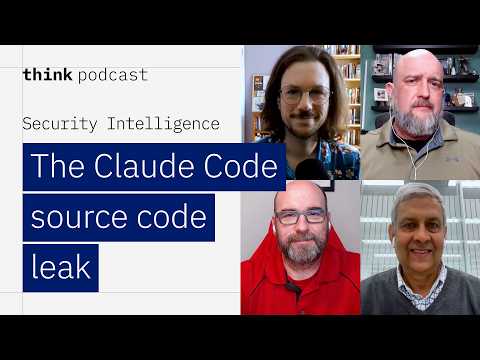
The Claude Code source code leak: Takeaways for cybersecurity pros
IBM Technology
This episode explores the systemic security risks associated with agentic AI, supply chain vulnerabilities in package managers, and how organizations can evolve their defense strategies to counter emerging cyber threats.
Key Takeaways
- Agentic AI and coding tools introduce new supply chain attack vectors that require organizations to prioritize secure software testing over blind dependency updates.
- The breach of security tools like Trivy demonstrates that a single leaked credential can compromise complex infrastructure, highlighting the urgent need for robust identity perimeter management.
- Encouraging a culture of 'near miss' reporting, similar to the NTSB in transportation, could provide critical, underutilized intelligence for proactive defense.
- Defensive strategies should evolve toward an 'AI-first' model to match the speed of automated threats, while maintaining human oversight for high-stakes decisions.
Talking Points
Pro Analysis
This discussion is strategically important because it shifts the focus from individual product vulnerabilities to the underlying systemic weaknesses of the 'agentic' AI ecosystem. As businesses rush to deploy AI-driven coding agents, they are inadvertently expanding their attack surfaces in manners that legacy security tools cannot detect.
Security professionals and AI integration leads should care deeply about this. The primary value lies in the call for an 'AI-first' defense; if defenders continue to operate at a human pace while adversaries use AI for automated reconnaissance and credential harvesting, the asymmetry will inevitably favor the attackers.
Contrarian Takeaway: Despite the industry-wide focus on 'AI-driven hacking,' the real threat is currently the human 'vibe coder'—an employee utilizing AI tools they do not fully understand to bridge shadow IT integrations. Ironically, the human operator, not the AI agent, remains the most volatile variable in the secure supply chain.
Time saved:
Written by: 1 Minute Signal Editorial Team