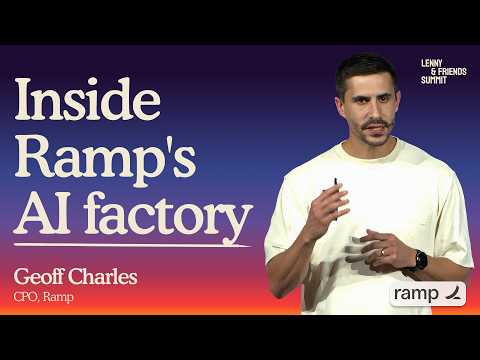
The limiting factor—how to design an AI software factory for speed | Geoff Charles (Ramp CPO)

Video thumbnail: The limiting factor—how to design an AI software factory for speed | Geoff Charles (Ramp CPO)
Sep 25, 202619m 31s video lengthLenny's Podcast

The Signal

Ramp—a financial technology company—argues that product development speed is governed by a shifting bottleneck rather than raw individual effort. By automating coding, testing, and coordination with custom agents, Ramp claims to have transitioned from coding-constrained to coordination-constrained workflows, asserting that leaders should stop managing feature delivery and start building the 'factory' that enables rapid automation.

The Case

  • Ramp claims its internal agents now handle 75% of pull requests (Inspect) and 93% of code reviews (Review Buddy), while a browser-based agent (Testo) caught 425 bugs in 30 days.8:42
  • The central management mechanism is 'bottleneck-shifting': once a specific process like coding is automated, human coordination and quality assurance inevitably emerge as the next primary constraint.2:56
  • Ramp built a customer-insight agent that aggregates fragmented signals from Gong, Zendesk, and Slack because manual data synthesis proved slower than the engineering cycle.4:59
  • The company frames its internal product operations as an F1 racing system, where performance depends on constant system iteration and removing obstacles around the 'driver' rather than just asking for harder work. ### PM Evolution1:11
  • The speaker argues that product management is splitting into three tracks: technical PMs who build the automation factory, taste-makers who set the product bar, and general managers who own business outcomes.16:53
  • Ramp advocates for making an entire organization 'machine-readable' by routing every question through formal records in tools like Notion and Linear, effectively turning organizational knowledge into an API.11:31

The 1 Minute Signal Take

Ramp's internal metrics and workflow framework suggest that software companies can move significantly faster by treating product development as a factory optimization problem rather than a craft-based coding exercise. Their evidence is entirely internal and self-reported, but the shift from 'shipping features' to 'building automated iteration loops' represents a high-trust model for scaling product output.

Pro Analysis

Why It Matters

This approach signals a transition from 'AI-assisted development' to 'AI-governed production.' By moving the locus of control from individuals to systemic loops, companies can theoretically decouple scaling from linear headcount growth.

Strategic Implications

Organizations that fail to treat their documentation and data as an API will struggle to integrate AI agents effectively. The long-term competitive advantage will accrue to those who successfully standardize their operational workflows to be 'machine-readable.'

Evidence & Hype Audit

While Ramp provides impressive internal metrics (e.g., 425 bugs caught by a QA agent in 30 days), these are self-reported and reflect a highly specific, disciplined engineering culture. The strategy assumes a level of architectural maturity—such as a clean codebase and standardized documentation—that most enterprises currently lack.

Counterarguments

Critics might argue that over-automating the 'product factory' risks creating a 'hallucination-loop,' where AI agents optimize for the wrong metrics because they lack genuine, messy human intuition. Additionally, replacing human oversight with agents may create 'black box' processes where engineers lose the deep, implicit understanding of the codebase required to debug systemic failures.

Who Should Care

  • CTOs/CPOs: Interested in re-engineering product development lifecycles.
  • Engineering Managers: Focusing on reducing 'toil' and automating code review.
  • Product Ops: Responsible for making internal information accessible and structured.

What to Do Next

  • Audit your development loop to identify the single most recurring 'time-sink' process.
  • Standardize documentation in tools like Notion or Linear to ensure agents can retrieve context.
  • Pilot a single-task agent to automate the most repetitive internal request.
  • Shift engineering resources from building new features toward building internal 'harnesses' that support autonomous testing.
Time saved:16m 37s

Share this

Tags

Written by: 1 Minute Signal Editorial Team