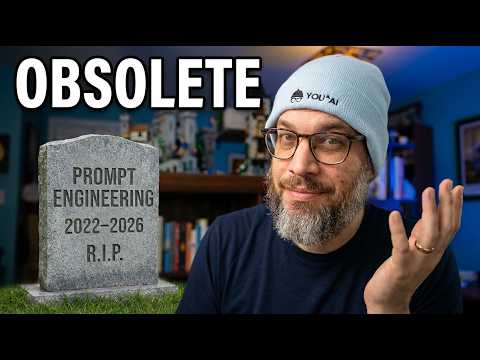
Opus 4.7 and OpenAI 5.5 Made Your Prompting Style Obsolete.

Video thumbnail: Opus 4.7 and OpenAI 5.5 Made Your Prompting Style Obsolete.
May 21, 202625m 4s video lengthAI News & Strategy Daily | Nate B Jones

The Signal

The central tension in AI workflows is whether we treat the technology as a junior partner needing rigid instruction—the 2025 'prompt engineering' paradigm—or as a senior partner capable of complex synthesis. The speaker argues that because recent models have improved significantly in tool use and context handling, high-end knowledge work now requires an 'AI question method,' where users drive outcomes with perspective and synthesis rather than task-based prompts. While the speaker asserts prompt engineering is now merely 'table stakes' rather than a differentiator, he acknowledges that the requirement for basic clarity remains.

The Case

  • The speaker frames the primary skill shift as moving from 'prompt engineer' to 'question designer,' where asking a structured series of inquiries mimics how one would leverage a senior coworker.2:23
  • The recommended method relies on three principles: explicitly stating your intent and bounds, requiring the model to synthesize what 'good' outcomes look like, and forcing the AI to integrate both formal data sets and your own implicit thesis.8:30
  • A hard boundary is drawn between interactive knowledge work and 'agentic pipelines'—the latter defined as buttoned-up, repeatable automations for tasks like invoice processing—which the speaker says have different design constraints.5:21
  • The speaker claims that specific recent updates to frontier models (referenced as '4.7' and '5.5') have triggered a 'second acceleration' in capability, though this claim is made without external audit or specific performance data.0:45
  • Concrete examples provided include using 'context folders' to analyze customer support tickets against marketing PRDs and product metrics, using the AI to stress-test whether product-led growth strategies are actually succeeding.17:41
  • The speaker admits this new, more collaborative model may not function as intended in older units, on free tiers, or within accounts subject to strict token limitations.7:24

The 1 Minute Signal Take

The speaker’s core premise—that we should shift from 'prompt engineering' to 'senior partner collaboration'—is a practical, well-structured framework for anyone doing complex knowledge work in frontier models. However, the video contains significant promotional hyperbole, specifically the unsupported claim of a '100x' increase in power, and the assertion that prompt engineering is 'dead' contradicts his own admission that basic task definition remains essential. Watch it for the actionable mental models regarding how to structure inquiries, but skip the rhetorical framing about prompt engineering's total obsolescence.

Pro Analysis

Strategic Significance

This transition marks the commoditization of input-structuring skills. As models become more capable of navigating ambiguity, the bottleneck shifts from technical prompt construction to the clarity of human intent and judgment. It elevates AI from a productivity tool to an active intellectual partner.

Who Should Care

  • Product Managers & Analysts: Those working across fragmented data streams (VOC, PRDs, analytics) who need to synthesize coherent narratives rapidly.
  • Knowledge Workers: Professionals currently struggling to get high-quality outputs from frontier models despite following traditional prompting 'best practices.'

Contrarian Takeaway

The speaker’s assertion that 'prompt engineering is dead' is a strategic provocation. The reality is that the new 'question method' is simply a more sophisticated form of prompt engineering. By branding it differently, the speaker successfully separates those who think in 'tasks' from those who think in 'systems,' effectively identifying the next generation of power users.

Time saved:22m 23s

Share this

Written by: 1 Minute Signal Editorial Team