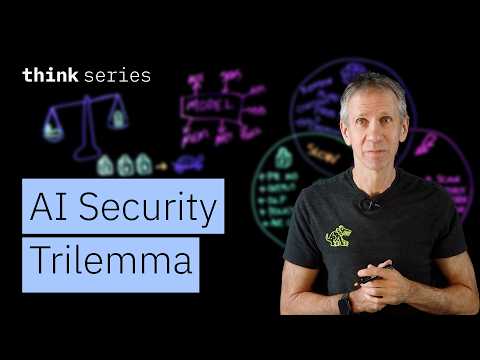
What Is the AI Security Trilemma? Smart, Fast, or Secure AI?

Video thumbnail: What Is the AI Security Trilemma? Smart, Fast, or Secure AI?
Aug 18, 20269m 3s video lengthIBM Technology

The Signal

AI system design is currently governed by a 'security trilemma'—the struggle to simultaneously maximize capability, speed, and security. Because increased intelligence expands the attack surface while security controls inherently add latency, architects must choose which trade-off to accept. This model acts as a heuristic for prioritizing system requirements by use case.

The Case

The Security Trilemma

  • Capability expands the attack surface, as smarter agents require more memory, autonomy, internet access, and tool permissions to function.3:21
  • Speed directly conflicts with security because effective inspection, prompt injection detection, and output validation require time that millisecond-latency systems cannot afford.1:47
  • Security mechanisms—including filtering, sandboxing, logging, and human-in-the-loop oversight—introduce friction, essentially trading responsiveness for safety.2:43

Mitigation and Strategy

  • Architects often use an external AI security proxy, an enforcement layer sitting outside the model, to handle policy and output sanitization without slowing down the model's core reasoning.7:47
  • This proxy balances the trilemma but does not resolve it, meaning designers must still prioritize two of the three traits based on specific task needs.8:37
  • Systems like deep research prioritize smartness and security, while low-risk home automation may trade intelligence for speed and safety, and proof-of-concept testing may prioritize speed and smartness over robust security.5:05

The 1 Minute Signal Take

The trilemma is a practical design constraint rather than a fixed law of physics, but it highlights why 'universal' AI security is impossible. You should assess whether your use case is risk-tolerant enough to sacrifice one of these pillars before attempting to build or deploy an agent.

Pro Analysis

Why It Matters

This framework moves the conversation away from vague 'AI safety' toward a concrete engineering discipline. It acknowledges that security is not a default state but an expensive constraint that competes with other desirable product features.

Strategic Implications

Businesses must move away from the 'all-of-the-above' approach to AI deployment. The trilemma forces a hard decision: if you are building an autonomous research assistant, you must plan for long-duration processing times rather than chasing instant responses. If you are building a consumer-facing chatbot, you must accept that high security or extreme model complexity may be impossible to achieve without sacrificing user experience.

Evidence & Hype Audit

This content is a heuristic model rather than a data-backed research paper. While logically sound and consistent with cybersecurity fundamentals, it treats the 'trilemma' as a law without providing boundary conditions. It is a highly useful mental model for architects, but should not be mistaken for an empirically proven physical constraint.

Counterarguments

Critics might argue that architectural innovations—such as specialized hardware for security or more efficient, distilled guard rails—could effectively negate the latency penalty, potentially 'solving' the trilemma in the near future.

Who Should Care

  • CTOs/Architects: Need to define the security-speed-intelligence budget early in the product lifecycle.
  • Security Engineers: Should focus on proxy-based architectures rather than model-level tuning.
  • Product Managers: Need to manage stakeholder expectations regarding why a 'smarter' AI might be slower or why a 'fast' one might have more restrictions.

What To Do Next

  • Map your current AI workflows against the three trilemma pillars.
  • Evaluate latency requirements to see where security controls can be offloaded to a proxy.
  • Define your 'minimum viable security' threshold to avoid unnecessary friction.
  • Benchmark your system's response times with and without active security guard rails.
Time saved:6m 13s

Share this

Tags

Written by: 1 Minute Signal Editorial Team