
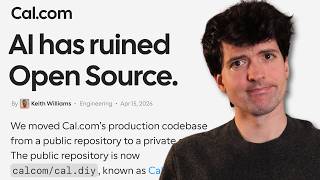

- AI drastically lowers the domain-specific knowledge required to identify critical security flaws in large, complex software projects.
- Security hardening is becoming a computational expense comparable to proof-of-work, where success is primarily determined by financial and compute resource allocation.
- Open-source maintainers face an escalating burden as they must now manage continuous, AI-driven security reports, which some critics incorrectly dismiss as unwanted noise.
Channel: Theo - t3․gg
Source Video
Why AI Security Risks Are Driving Open Source Projects Closed
This video examines how the emergence of AI-driven vulnerability discovery is forcing companies to reconsider the security implications of maintaining open-source codebases. It explores the shift toward prioritizing 'proof-of-spend' security strategies to defend against automated exploit generation.
Key Takeaways
- AI reduces the barrier to finding security vulnerabilities by allowing attackers with minimal domain knowledge to use automated agents against accessible source code.
- Security has evolved into an arms race defined by 'proof-of-work' or 'proof-of-spend,' where organizations must out-spend attackers to harden their code effectively.
- The shift toward closed-source software is often a tactical, short-term response to the current automated threat landscape, rather than a permanent solution to security sustainability.
Talking Points
Analysis
This analysis is vital because it reframes cybersecurity from a human-centric skill gap to a resource-expenditure equation. For te...
Full analysis available on Pro.
Time saved:
Channel: Theo - t3․gg