
Back to Feed
The data black hole at the center of AI
The Signal
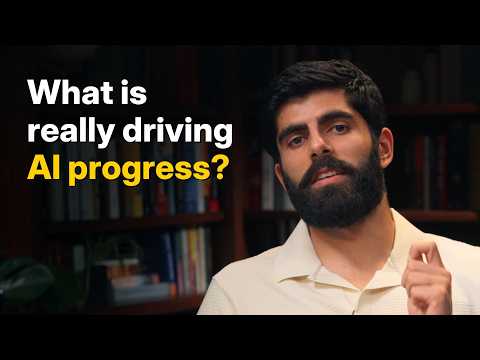
AI progress is currently driven less by model architecture and more by the high-compute distillation of expert data, according to speaker Dwarkesh Patel. He identifies a profound sample-efficiency gap between humans and LLMs, arguing that brute-force parameter scaling cannot close this gulf because humans learn significantly more from less data than models do. The central tension lies in whether these inefficiencies will block broader intelligence gains or if laboratories will successfully automate AI research itself to solve the bottleneck through recursive improvement.
The Case
- AI gains are primarily a data-distribution problem, as evidenced by the quick catch-up times of open-source models; Patel cites an Epoch report that open models currently lag frontier systems by just four months, suggesting architecture is easier to mirror than the massive data pipelines labs employ.
- Scaling parameter counts has diminishing returns for data efficiency; Patel argues, based on Chinchilla scaling laws, that even increasing parameters by infinity would only reduce data requirements by a factor of ten, failing to bridge the reported millionfold sample-efficiency gap between human lifetime learning and model training.
- The labs’ current path is recursive: they aim to automate white-collar tasks while prioritizing the automation of AI research itself, planning to use those automated researchers to eventually resolve the fundamental sample-efficiency problem.
- Training remains economically viable despite human-model efficiency mismatches because AI training costs—even when requiring thousands of human-expert rubrics or rollouts—can be amortized across billions of usage sessions.
- Software engineering is identified as a job category likely to involve non-repetitive, out-of-distribution reasoning; Patel speculates that human demand for such roles may actually be higher in 2028 than today because AI tools will shift the nature of the work rather than simply replacing the worker.
- The comparison of human and AI learning efficiency is a matter of intense debate; Patel flags evolution as a suboptimal “pretrained” analogy for AI, noting the human genome's small size makes it a poor candidate for storing the weights of a fully-formed model.
The 1 Minute Signal Take
Patel makes a compelling case that scaling laws are being misinterpreted as the only path to intelligence, shifting the conversation toward the unsexy economics of data generation and expert-labeling pipelines. The video is worth watching for the specific structural critique of scaling laws—a perspective often sidelined in favor of pure performance metrics—but skip it if you are already intimately familiar with the economics of synthetic data and GRPO-style RL training. The speaker’s betting-style predictions (like 2028 software engineering demand) are purely speculative and lack empirical support.
Time saved:
Tags
Back to Feed