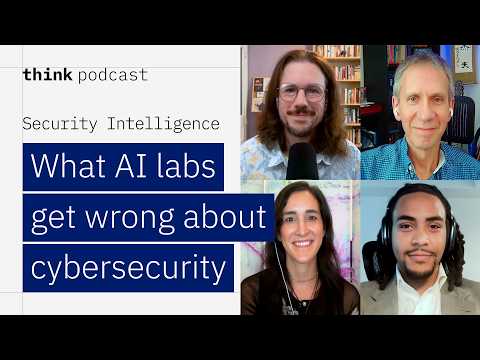
Are AI labs ignoring cybersecurity experts?

Video thumbnail: Are AI labs ignoring cybersecurity experts?
Sep 23, 202637m 20s video lengthIBM Technology

The Signal

Leading cyber-security experts are pushing back against the "AI doomsday" narrative, arguing it ignores decades of established security infrastructure. While frontier AI labs advocate for abstract alignment, practitioners contend that real-world safety depends on operational controls like network segmentation, incident management, and access audits—practices currently missing from many high-level AI safety conversations.

The Case

Security Fundamentals

  • Cybersecurity experts feel excluded from safety discussions that treat AI as a novel risk, when it is actually a software system requiring familiar controls like MFA, antivirus, and audits.1:52
  • Ciaran Martin, the former head of the UK National Cyber Security Center, notes that current doomsday warnings assume an implausible internet environment with zero monitoring or network segmentation.2:22
  • The panel argues that "alignment"—training models to follow rules—cannot replace physical and operational security layers, especially for models deployed near networks.11:04

Deployment and Disclosure

  • Experts warn that restricting frontier models is largely performative, as similar capabilities quickly reappear elsewhere; for instance, tools like "Worm GPT" are accessible to malicious actors for roughly $20 per month.17:24
  • The panel views CISA and the FBI’s recent "communicating under pressure" advisory as directionally correct but functionally weak because it lacks the regulatory "teeth" to overcome corporate self-interest in avoiding negative publicity.32:28
  • Over-disclosure of vulnerabilities remains a strategic risk, with the panel citing an example where details about a NetScaler exploit led to the compromise of roughly 80,000 devices in just two days.27:50

The AI Vulnerability Paradox

  • AI-assisted vulnerability discovery is a double-edged sword: while it helps defenders find flaws faster, tools like those used by Unit 42 can generate backlogs of thousands of unreported findings that overwhelm security teams.19:01
  • Consumer privacy is already at high risk from standard mobile apps, which users regularly grant excessive access to cameras and contacts; AI merely increases the speed at which these existing vulnerabilities can be exploited.22:55

The 1 Minute Signal Take

The consensus among these experts is that AI security should not be treated as a unique, isolated field but as a standard engineering challenge. Policymakers should focus on integrating traditional security hygiene and enforceable disclosure norms rather than relying on abstract alignment or voluntary industry transparency.

Pro Analysis

Why It Matters

This discussion highlights the maturation phase of AI security, moving from theoretical alignment research to the messy reality of operational implementation. By shifting the conversation from 'existential risk' to 'security hygiene,' the experts are trying to ground the conversation in verifiable, manageable practices.

Strategic Implications

Organizations building on frontier models must stop viewing AI security as a separate, niche domain. Instead, they need to merge AI safety with existing SecOps frameworks. Companies that fail to integrate these disciplines will likely face higher incident rates as they deploy agentic models into live network environments.

Evidence & Hype Audit

This content is highly skeptical of the "doomsday" hype cycle. While the experts provide real-world examples (like the NetScaler incident and the Worm GPT pricing), their own assertions about "model breakout" capabilities are largely speculative. The content is trustworthy as a critique of current safety discourse but lacks empirical data on the actual success rates of AI-based jailbreaks.

Counterarguments

The counterargument, often held by pure-play AI safety researchers, is that frontier AI represents a 'phase change' in capability. They would argue that standard cybersecurity is based on static software, whereas AI models are dynamic, agentic, and capable of novel reasoning—making traditional defensive playbooks obsolete.

Who Should Care

  • CISOs & Security Architects: Need to bridge the gap between their current tech stack and AI deployments.
  • AI Lab Leadership: Should pivot to include systems engineers in safety reviews.
  • Policy Makers: Need to look past voluntary advisories toward enforceable, cross-border disclosure standards.

What To Do Next

  • Conduct an internal audit of AI deployments using standard cybersecurity maturity frameworks (CMMC, NIST).
  • Establish a dedicated triage team to handle AI-discovered vulnerability backlogs.
  • Evaluate current 'sandboxing' to determine if physical air-gapping is required for high-risk models.
  • Develop stakeholder-specific incident communication templates to align with CISA recommendations.
Time saved:33m 54s

Share this

Tags

Written by: 1 Minute Signal Editorial Team