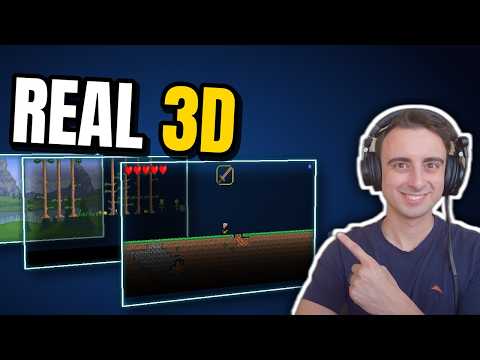
Minecraft 3DS Had a Secret 3D Mode. AI Brought It Back.

Video thumbnail: Minecraft 3DS Had a Secret 3D Mode. AI Brought It Back.
Nov 3, 202619m 16s video lengthMattVidPro

The Signal

Using AI-assisted reverse engineering, a developer has successfully patched native 3D stereoscopic support into Minecraft and Terraria for the 3DS. By reading machine code and iterating through live hardware testing, the project overcame original performance and comfort hurdles that likely deterred official development, resulting in playable, open-source modifications that restore long-lost or missing hardware capabilities.

The Case

Reverse Engineering Method

  • The developer utilized Claude Code to analyze machine code and patch rendering paths in real time, a process that took approximately 12 to 16 hours of development time to achieve functional prototypes.16:45
  • Real-world hardware testing proved essential because emulators consistently masked critical failures, including hardware crashes and timing inconsistencies, that were not visible in development environments.5:55
  • The team moved from a naive dual-rendering approach—which was CPU-intensive and caused gameplay issues—to a GPU-optimized trick that renders the scene once and reuses the frame with a horizontal shift to create parallax.8:18

Game-Specific Breakthroughs

  • Minecraft 3DS appeared to contain remnants of an official 3D renderer in its code before updates removed it; the mod reconstructs this logic using official camera math and eye-matrix shaders.4:34
  • Terraria 3DS modding achieved true layered 3D on old 3DS models by placing a 240x400 right-eye image in unused video memory, a technique that costs zero extra game memory.11:30
  • The Terraria modification also incorporates several quality-of-life improvements, including item sorting, C-stick support, a fake OLED color mode, and increased stack limits, while fixing persistent crashes related to world-map memory usage.13:49

Legal and Stability Context

  • The developer released the mods as open-source MIT projects on GitHub, explicitly requiring users to provide their own legally acquired game files and a modded 3DS console.11:03
  • While the developer cites Sega v. Accolade as precedent for the legality of reverse engineering, they emphasize that these claims are not formal legal advice and note that hardware modification carries the minor risk of save data loss during crashes.17:50
  • The assertion that these 3D features were abandoned solely due to cost is disputed, as the speaker’s own early playtests revealed that rendering at roughly 17 Hz per eye caused severe nausea, potentially explaining the original omission.6:55

The 1 Minute Signal Take

This project demonstrates that AI-assisted reverse engineering can significantly lower the barrier for restoring hardware-specific features in abandoned software, provided one is willing to iterate on physical hardware to bypass emulator inaccuracies. For the user, these mods represent a rare instance of a community filling gaps left by original developers, though the stability of such projects remains dependent on continued community maintenance.

Pro Analysis

Why It Matters

This project serves as a landmark demonstration of how LLMs have fundamentally altered the economics of hobbyist reverse engineering. Tasks that previously demanded specialized expertise and months of tedious labor are now accessible to individuals who can manage iterative, AI-guided workflows.

Strategic Implications

Software preservationists should note this shift. The ability to inject modern functionality—or restore discarded features—into legacy binary-only software effectively turns 'dead' games into living, moddable platforms. This lowers the barrier for community-driven maintenance of legacy software that manufacturers have long abandoned.

Evidence & Hype Audit

While the project is technically sound and the results are reproducible via the open-source code, the speaker exhibits typical 'creator bias.' Assertions that these versions are the 'end all be all' or that features were removed because they 'weren't worth it' are speculative and lack official documentation. The performance claims are well-supported by the described technical tricks, but these should be treated as highly optimized custom patches rather than universal performance gains.

Counterarguments

Critics might argue that even with AI assistance, the process is inherently dangerous. Modifying closed-source binary code risks unpredictable memory corruption. Relying on an AI to 'guess' logic pathways can lead to subtle bugs that might not appear in testing but could emerge under specific, un-simulated gameplay conditions.

Who Should Care

  • Game Developers: To understand how AI-assisted refactoring can optimize rendering pipelines.
  • Modding Communities: As a blueprint for using AI to decompile and patch legacy titles.
  • Hardware Collectors: For those seeking to maximize the utility of their existing 3DS library.

What to Do Next

  • Download the source from the public GitHub repository to review the implementation.
  • Perform a clean, legal dump of your existing game cart to verify compatibility.
  • Use the provided plugin menu to experiment with depth presets.
  • Engage with community forums for current stability updates.
  • Compare the modded performance against stock settings to document optimization gains.
Time saved:15m 27s

Share this

Tags

Written by: 1 Minute Signal Editorial Team