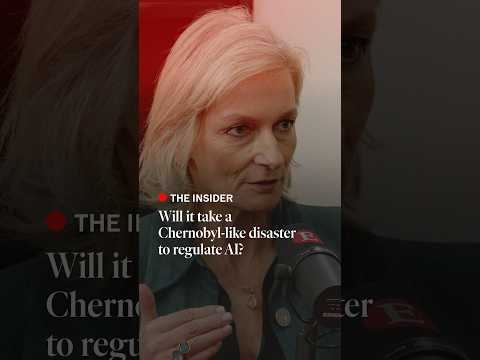
Will it take a Chernobyl-like disaster to regulate AI? | The Economist

Video thumbnail: Will it take a Chernobyl-like disaster to regulate AI? | The Economist
Oct 9, 20261m 4s video lengthThe Economist

The Signal

Meaningful AI policy shifts remain unlikely until a major disaster forces political action. The speaker contends that significant regulation typically follows crises—specifically severe financial loss or loss of life—and argues against the fatalistic view that catastrophic outcomes are inevitable, maintaining that humans retain the agency to shape policy through iterative, incremental oversight.

The Case

The Trigger for Policy

  • The speaker predicts major regulatory movement will only occur after a "big-ish" event, such as a substantial financial collapse or a significant loss of life.0:00
  • This "Chernobyl of AI" moment is expected to happen reasonably soon, serving as the necessary catalyst to alter current political dynamics.

The Argument for Agency

  • The speaker explicitly rejects the fatalistic assumption that current competitive race dynamics make a 10% chance of human extinction inevitable.0:23
  • Human agency is framed as the key variable, suggesting that outcomes are not predetermined and that a viable, non-catastrophic path exists.

The Model for Governance

  • Governance should mimic the historical regulation of cars and medical innovations, which developed incrementally after real-world failures rather than through total, preemptive control.
  • The iterative process—characterized by mistakes, periodic overkill, and eventual rollback—is presented as a pragmatic and functional way to build robust systems.
  • The speaker advocates for "not too intrusive" regulation, arguing that incremental adjustments remain effective even when initially imperfect.0:54

The 1 Minute Signal Take

The speaker’s argument hinges on a historical preference for reactive, iterative policy over proactive, maximalist control. Whether this incremental approach can actually manage AI risks—which may escalate faster than the regulatory response cycles of the automotive or medical industries—remains a central, unresolved point of contention.

Pro Analysis

Why It Matters

The core tension identified is between the urgency of existential risk and the reality of political responsiveness. The video highlights that regulatory bodies are inherently reactive, suggesting that we may be unable to prevent certain classes of AI risk until they are manifested in the real world.

Strategic Implications

For policy-makers, this implies a need for 'modular' regulation—legislation designed for quick iteration and rollback. For organizations, it highlights the importance of internal safety benchmarks to avoid being the target of the eventual 'over-correction' policy that follows a disaster.

Evidence & Hype Audit

The content relies heavily on historical analogy rather than empirical data regarding AI-specific safety. It is philosophically grounded and serves as a qualitative assessment of political reality rather than a predictive model. It avoids typical tech-hype by grounding the conversation in the messy reality of legislative history.

Counterarguments

Critics might argue that AI presents an 'asymmetric' risk unlike cars or medicine; if a 'Chernobyl' happens with AGI, the subsequent regulation may arrive too late to matter, as the disaster itself could be terminal for the governing society.

Who Should Care

  • Policy Analysts: Should focus on creating iterative frameworks.
  • Safety Researchers: Should focus on communicating clear, small-scale failures to trigger incremental regulation before a terminal event occurs.
  • Corporate Strategy: Should prepare for a reactive legislative environment.

What to Do Next

  • Develop 'tripwire' indicators for AI failure.
  • Build coalition support for flexible, sector-specific oversight.
  • Avoid the 'all or nothing' regulatory trap.
  • Map historical regulatory failures of legacy industries for AI policy parallels.
  • Engage in transparent risk-sharing to mitigate the severity of the 'first event.'

Share this

Tags

Written by: 1 Minute Signal Editorial Team