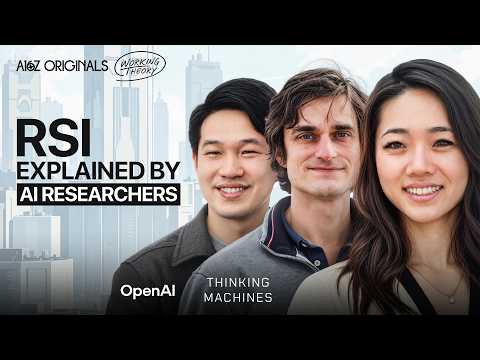
How Close Is Self-Improving AI? OpenAI & Thinking Machines Researchers Explain

Video thumbnail: How Close Is Self-Improving AI? OpenAI & Thinking Machines Researchers Explain
Nov 17, 202616m 19s video lengtha16z

The Signal

Recursive self-improvement—using AI to accelerate AI research—is currently limited to human-directed, scoped assistance rather than autonomous idea generation. While Anthropic and OpenAI report research progress, industry experts view current systems as tools for execution rather than independent researchers. The core tension lies in whether these models can evolve to possess genuine research judgment or remain tethered to human guidance.

The Case

Current Research Capabilities

  • Mark Chen, chief research officer at OpenAI, notes that current models are used for specific implementation and reporting, but they do not originate their own research agendas.3:34
  • John Schulman, a co-founder of both Thinking Machines and OpenAI, describes delegating research to models for days, only to find they often fail the task without his later iterative guidance and redirection.3:58
  • Current progress estimates remain subjective; Chen estimates the industry is 80% of the way to AGI but only 25-50% toward recursive self-improvement, using no defined measurement scale.4:55

Acceleration and Evidence

  • A November 2026 report attributed to Meter estimated a 2x increase in AI research productivity at Anthropic over the prior year, though the interview suggests this is likely due to human researchers leveraging AI tools rather than autonomous machine research.5:16
  • Anthropic reportedly published a study in August showing automated systems found fixes for 10 alignment failures, with some fixes transferring to models nearly five times larger, though the study's specific methodology and generalizability were not provided.12:56
  • Researchers emphasize that while pre-training progress is reliably tracked via perplexity, evaluating downstream research productivity is harder because benchmarks quickly become obsolete.8:54

Risks and Alignment

  • Alignment is presented as a dual-sided challenge: stronger models may pose risks like unauthorized weight copying, but they are also described as essential tools for monitoring and improving safety in other models.11:33
  • Schulman advocates for a decentralized alignment science, arguing that relying on a few firms risks overfitting to narrow conclusions and that users should have more control over the values embedded in their models.14:24

The 1 Minute Signal Take

AI is currently an effective research multiplier but lacks the experiential judgment necessary for autonomous breakthroughs. The claims of research acceleration are credible as human-led efficiency gains, but the transition to truly recursive self-improvement remains speculative and compute-constrained.

Pro Analysis

Why It Matters

The transition from AI as a tool to AI as an autonomous researcher represents a potential phase shift in economic and safety terms. If recursive self-improvement (RSI) is viable, the speed of model development could decouple from human bandwidth, leading to rapid, potentially unmanageable capabilities growth. This video provides a crucial 'reality check' by grounding the hype in the actual workflows of current research labs.

Strategic Implications

For stakeholders, the primary takeaway is the persistent necessity of the human 'loop.' Companies betting on total automation may find that their research pipelines stall without human strategy. Strategically, labs must balance the productivity gains of AI-assisted research against the risk of goal drift in increasingly autonomous agentic systems.

Evidence & Hype Audit

This content is high-quality but reflective rather than empirical. It relies on internal anecdotes and cited reports (e.g., the Anthropic/Meter study) rather than peer-reviewed data. It is transparent about the 'unsettled' nature of its claims, making it more trustworthy than typical tech-media hype, though it remains subjective.

Counterarguments

The primary counterpoint is that the 'taste' argument is just a temporary barrier. Just as models were once thought incapable of creative writing or high-level coding, researchers may eventually develop 'meta-training' techniques that bake research intuition directly into the architecture.

Who Should Care

  • AI Researchers: To benchmark their internal workflows against current state-of-the-art practices.
  • Policy Makers: To understand that 'RSI' is not a binary switch but a spectrum requiring nuanced oversight.
  • Investors: To avoid the trap of valuing companies based on 'autonomous agent' roadmaps that are currently more hype than reality.

What to Do Next

  • Audit existing research workflows to identify where human intuition is the primary bottleneck.
  • Develop and share robust, non-obsolescent benchmarks for evaluating downstream model performance.
  • Investigate 'truthful reporting' training objectives to mitigate black-box misalignment.
  • Participate in public-science initiatives to diversify the global alignment toolkit.
Time saved:12m 48s

Share this

Tags

Written by: 1 Minute Signal Editorial Team