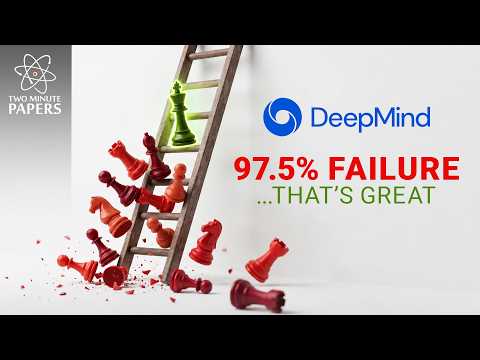
DeepMind’s New AI Found A Strange New Way To Think

Video thumbnail: DeepMind’s New AI Found A Strange New Way To Think
Jun 5, 20267m 30s video lengthTwo Minute Papers

The Signal

DeepMind’s new system reports solving nine previously unsolved Erdős problems from a curated subset of 350. The presenter argues this success marks a shift from relying on raw model intelligence to building tighter, iterative harnesses, though the result remains contested due to potential selection bias and the system's reliance on large base models.

The Case

  • AlphaProof Nexus, the reported system, uses Lean—a formal proof language—and an iterative loop where an AI agent attempts proofs, a critique model refines them, and a judge model selects winners.2:00
  • The system achieved a 95.7% failure rate across the 350-problem subset, solving nine items at an estimated cost of a couple hundred dollars per successfully verified proof.0:29
  • The subset tested was explicitly chosen for ease of formalization, leaving it unsettled whether this approach can scale to the full set of approximately 1,200 Erdős problems.4:49
  • Smaller models performed entirely unsuccessfully in this configuration, indicating that a complex harness does not yet act as a complete substitute for high-level base model capability.5:17
  • The claim that "everyone is doing" this formalization loop today is an unsupported marketing-style assertion; similarly, the presenter's framing that the judge "cannot lie" is rhetorical rather than a proven reliability metric.

The 1 Minute Signal Take

This result is a legitimate, documented milestone in proof-search automation, but the presenter’s framing of a "clear" progression remains speculative. The video is worth a watch to see the exact tournament loop architecture, but skip it if you are looking for an unbiased analysis of the method's generalizability beyond the cherry-picked benchmark.

Pro Analysis

Strategic Significance

This development signals the maturation of AI from simple pattern-matching engines into rigorous, verify-then-validate reasoning systems. By integrating formal verification, we can finally bypass the 'hallucination' barrier in symbolic domains like mathematics.

Who Should Care

  • Algorithm Researchers: Those building agentic loops will find this proof-search architecture highly relevant for handling complex, multi-step Reasoning tasks.
  • Formal Verification Engineers: The success of Lean in this context validates the utility of bridging symbolic logic with neural network generation.

Contrarian Takeaway

Despite the excitement over 'harnesses,' the absolute failure of smaller models underscores that you cannot scaffold your way to intelligence if the base model lacks minimal sufficiency. The 'harness-first' trend may lead to over-investment in complex loops for models that simply aren't smart enough to provide a viable starting point.

Time saved:5m 29s

Share this

Tags