
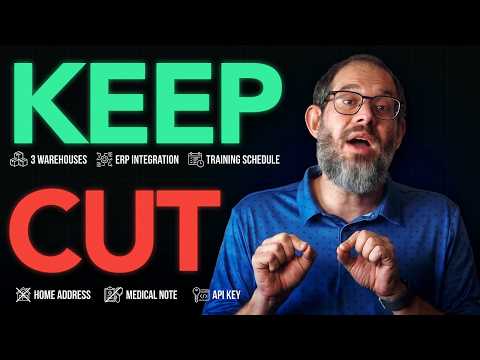
Why it Matters
This content shifts the AI privacy debate from abstract fear-mongering to the concrete engineering of workflows. It recognizes that privacy is a friction problem, not just a policy one. If security tools do not match the velocity and complexity of modern work, they will simply be ignored.
Strategic Implications
Organizations must pivot away from 'don't touch' policies toward creating 'safe-path' tooling. If you are a developer or a security leader, you need to acknowledge that your power users are going to use AI; providing them with wrappers or local-only processing pipelines is the only way to retain control. Ignoring this leads to the 'shadow IT' reality documented in the telemetry cited.
Evidence & Hype Audit
The content relies on a mix of plausible enterprise telemetry (Verizon) and the presenter’s personal experience. While the '100x' growth claim is likely rhetorical hyperbole, the underlying observation—that document-heavy AI use is increasing—is backed by observable trends in how professionals use tools like Claude or ChatGPT. It is not objective research, but it is high-fidelity practical insight.
Counterarguments
The strongest counterpoint is that 'sanitization' is a false sense of security. A user might overestimate their ability to identify what is sensitive, leading to the accidental exposure of proprietary 'Project Lantern'-style secrets. Furthermore, some legal and compliance domains do not permit any AI processing, regardless of how effectively a document is cleaned, due to the inherent opacity of model logic.
Who Should Care
- Security Architects: Design workflows that don't force users to choose between productivity and compliance.
- Managers: Recognize that your team is likely using AI on unapproved accounts; offer them a better, officially sanctioned way.
- Users: Start treating AI documents like public-facing materials—if you wouldn't send it to a contractor, don't raw-paste it into an AI interface.
What to do Next
- Map your most common AI-work tasks to sensitivity levels.
- Audit your team’s 'side-loading' of data into personal AI accounts.
- Establish a standard for 'minimum viable context' for your recurring tasks.
- If you build tools, shift from redaction to 'distillation'—rebuilding files rather than masking them.
- Define clear 'protected terms' lists for your projects to guard against context-sensitive leaks.