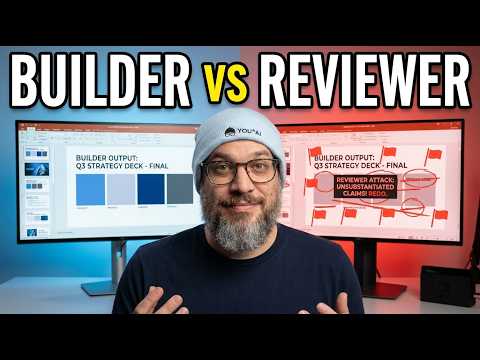
I Built a Deck With AI, Then Made a Second AI Attack It.

Video thumbnail: I Built a Deck With AI, Then Made a Second AI Attack It.
May 27, 202619m 29s video lengthAI News & Strategy Daily | Nate B Jones

The Signal

AI-driven Office artifact production (Excel and PowerPoint) is currently treated as a prompt-and-get process, but this speaker argues serious knowledge work requires a disciplined production system. The central tension is between casual prompting and a mandatory four-stage workflow—source prep, structure, constrained generation, and hostile verification—to prevent polished yet structurally defective artifacts. While the speaker asserts this approach is the necessary standard for high-stakes 2026 workflows, the universal applicability and productivity gains remain unsettled claims.

The Case

  • Polished, professional-looking files often conceal failures in logic or data integrity, such as an incorrect revenue growth formula replicated across a financial model or the conflation of Q3 actuals and Q4 projections in board presentations.2:25
  • A robust pipeline begins with a controlled source packet that indexes files by status and origin, preventing the model from blending disparate transcripts, plan data, and assumptions into a singular, untraceable synthesis.8:03
  • Before generating content, users must define a 'file blueprint' or specifications in plain English: a narrative spine for decks or a tab architecture for workbooks that mandates where truth, assumptions, and checks reside.8:55
  • The speaker employs a two-model adversarial loop: utilizing Codeex to construct artifacts and Claude Opus 4.7 to provide hostile, iterative reviews that enumerate unsupported claims or trace errors without immediately attempting fixes.13:03
  • Review intensity must scale with task-specific risk, where financial calculations and regulatory language demand more aggressive gatekeeping than summary text or document formatting.11:38
  • The speaker acknowledges that generic, push-button AI Office solutions are currently unfeasible because high-utility knowledge work is intrinsically domain-specific and requires manual integration of deep, contextual data.17:38

The 1 Minute Signal Take

The speaker’s workflow-first approach addresses the genuine and documented risk that AI models produce plausible hallucinations while maintaining high visual polish. While some claims regarding broad 'order of magnitude' productivity gains are aspirational and lack independent audit, the four-stage verification loop is a high-utility framework for any professional handling decision-grade data. Watch this video if you want the specific prompting structures and adversarial reviewer scripts needed to implement this workflow, as the text summary covers the strategy but not the tactical execution.

Pro Analysis

Strategic Significance

This approach signals a transition from 'AI as a chatbot' to 'AI as a production worker.' The professional standa...
Full analysis always available on Pro.

Time saved:17m 35s

Share this

Tags

Written by: 1 Minute Signal Editorial Team