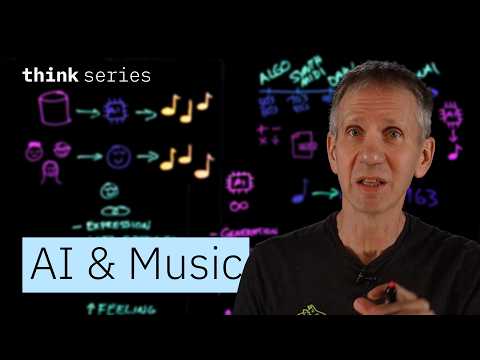
AI & Music: How AI Is Changing Music Creation & Creativity

Video thumbnail: AI & Music: How AI Is Changing Music Creation & Creativity
Oct 4, 202617m 18s video lengthIBM Technology

The Signal

AI is rapidly transforming music production, not as a revolutionary creative entity, but as an intensified tool for recombination. By automating speed, scale, and opacity in composition, AI challenges traditional notions of authorship. The central tension lies in whether listeners accept this as legitimate artistic collaboration or dismiss it as derivative 'AI slop.'

The Case

The Recombination Shift

  • Music has always evolved through technological mediation, from the piano and electric guitar to MIDI and digital audio workstations.3:18
  • AI does not invent the concept of musical borrowing; it accelerates the speed and scale at which existing patterns, harmonies, and textures are rearranged.2:14
  • Listeners frequently cannot distinguish between composed, improvised, or AI-assisted music, suggesting that provenance is often less critical than emotional impact.0:58

The Collaboration Matrix

  • AI tools now operate across the entire production pipeline, including real-time improvisation, voice style transfer, lyric generation, and automated audio cleanup.7:42
  • Production is no longer binary; creators can choose their level of AI involvement, ranging from human-only performance to AI-generated drafts that undergo human revision.10:45
  • The speaker argues that AI should be viewed as an 'assistant' rather than a replacement, as humans retain unique advantages in live performance, cultural context, and subjective meaning.14:37

The Future Outlook

  • Because AI systems improve with data and iterative use, the speaker asserts that the technology is irreversible and will inevitably integrate into personalized playlists and adaptive game music.15:01
  • The ultimate value of a piece of music remains its ability to resonate with human experience, regardless of whether a human or machine generated the initial arrangement.16:37

The 1 Minute Signal Take

Do not preemptively dismiss AI music based on the label, but judge it by its capacity to move you. Treat AI as a high-velocity collaborator that handles the tedious scaling of patterns, leaving the burden of emotional connection and final curation firmly with the human artist.

Pro Analysis

Why It Matters

This analysis moves the discourse away from the binary of 'AI versus human' toward a nuanced understanding of music as a perpetually evolving technology stack. By acknowledging that music has always been mediated, we can better anticipate how AI will integrate into the creative pipeline as an extension of existing DAWs and synthesizers.

Strategic Implications

Creators who view AI as a 'force multiplier' rather than a replacement will likely gain an advantage in terms of production volume and technical exploration. The shift towards hyper-personalized and real-time adaptive music suggests that professional musicians may soon need to design systems or environments rather than just static song structures.

Evidence & Hype Audit

  • Hype: The speaker uses highly confident, rhetorical language (e.g., 'the toothpaste is not going back into the tube') to frame adoption as inevitable.
  • Evidence: The content relies heavily on historical analogy (blues/folk/jazz) to support claims of recombination, which is philosophically sound but lacks empirical data on how large-scale generative models disrupt the economic value of human labor.

Counterarguments

Critics might argue that while AI is indeed a 'tool,' its scale-based nature fundamentally alters the 'attention economy' of music. Even if the music itself is good, the flooding of the market with high-fidelity, algorithmically generated content could diminish the discovery and cultural impact of human-made art.

Who Should Care

  • Musicians: Need to learn how to integrate AI to remain competitive in output speed.
  • Producers/Engineers: Should treat AI as a workflow assistant for repetitive tasks like mastering and noise reduction.
  • Fans/Listeners: Should develop a more critical ear for what defines 'authentic' experience in an era of synthetic production.

What to do next

  • Audit your current workflow to identify repetitive, non-creative tasks suitable for AI automation.
  • Experiment with voice style transfer or arrangement tools to see if they spark new creative directions.
  • Reassess your creative goals to prioritize the emotional 'human' core of your performances.
  • Monitor emerging AI-driven instruments and interactive music platforms as potential new performance mediums.
  • Maintain a clear distinction between 'utility' AI (cleanup) and 'creative' AI (composition) in your own practice.
Time saved:13m 52s

Share this

Tags

Written by: 1 Minute Signal Editorial Team