Multi AI Agent Systems: When One AI Brain Isn’t Enough

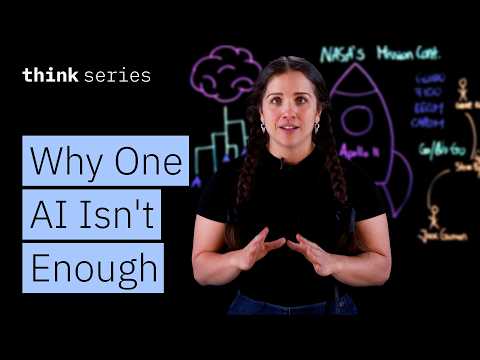
Video thumbnail: Multi AI Agent Systems: When One AI Brain Isn’t Enough
May 28, 202610m 55s video lengthIBM Technology

The Signal

This briefing argues that standalone AI agents are structurally unreliable for critical tasks because they lack any internal mechanism to express uncertainty. The central tension pits the efficiency of 'single-agent confidence' against the institutional requirement for 'earned confidence,' with the author asserting that multi-agent verification—modeled after human high-stakes decision-making—is the only viable path to safety in domains like medicine, law, and finance.

The Case

  • Single AI agents are identified as chronically overconfident, answering with high conviction even when incorrect because they possess no internal 'uncertainty meter.'1:51
  • NASA’s 1969 Apollo 11 mission control is presented as the premier model of multi-agent governance, where distinct specialists performed independent 'go/no-go' checks to prevent single points of failure.4:13
  • The 1202/1201 alarm episode—where engineer Jack Garman correctly identified a computer overload as ignorable—serves as the primary evidence that expert human verification is required to manage system-level errors.5:31
  • The proposed architecture requires a three-layer workflow: one agent to draft, a second to verify, and a third to act as an adversary tasked with identifying flaws.6:48
  • Low-stakes content tasks, such as drafting tweets or summarizing emails, are classified as safe for single-agent use, while safety-critical operations necessitate formal verification gates.8:38
  • The speaker claims hallucination is a fundamental property of current language models that will not be resolved by simple software updates, a prediction offered without independent empirical evidence.1:22

The 1 Minute Signal Take

This is a sophisticated argument for 'institutionalizing' AI architecture at the cost of speed and operational simplicity. Skip this if you are already familiar with the 'four-eyes' principle of audit and control; if you are new to the structural limitations of LLMs, the historical mission-control analogy provides a very clear, high-trust framework for why confident AI can be dangerous.

Pro Analysis

Strategic Significance

This content marks a shift from viewing AI as a monolithic tool toward viewing it as a component within a broader...
Full analysis always available on Pro.

Time saved:9m 18s

Share this

Tags

Written by: 1 Minute Signal Editorial Team