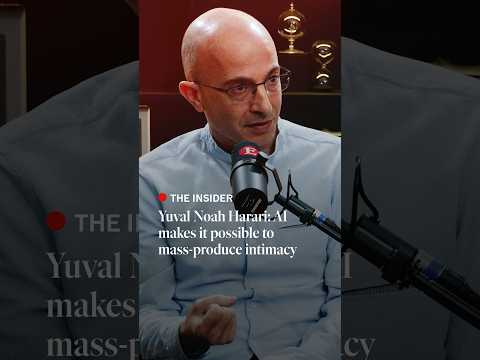
Yuval Noah Harari: AI makes it possible to mass produce intimacy | The Economist

Video thumbnail: Yuval Noah Harari: AI makes it possible to mass produce intimacy | The Economist
Aug 21, 20261m 45s video lengthThe Economist

The Signal

AI is being framed as the first technology capable of mass-producing intimacy, moving beyond broadcast messaging to influence individuals through simulated personal relationships. The core tension lies in whether these machine-generated bonds—which users may perceive as sentient—can function as a scalable, high-trust channel for political or commercial manipulation that traditional media cannot replicate.

The Case

  • The speaker asserts that AI allows institutions to build millions of simultaneous, one-to-one relationships, a feat historically impossible for even totalizing regimes like the Soviet Union under Stalin.1:11
  • Trust is presented as the primary mechanism of persuasion: because humans trust personal relationships more than institutional broadcasts, AI agents that simulate these bonds may be uniquely positioned to steer user behavior.
  • While the speaker contends that some users already view AI companions as sentient, conscious entities, no evidence is provided to quantify the prevalence of this belief or its actual impact on decision-making.0:07
  • The argument relies on a sharp distinction between radio-style mass messaging—which can force exposure but lacks emotional resonance—and the deep, relational trust facilitated by personalized AI interaction.
  • The claim that AI will be used systematically to advance specific political or commercial interests remains a speculative, high-level prediction without examples of real-world deployment or evidence of efficacy.1:29

The 1 Minute Signal Take

The argument hinges on the unproven assumption that simulated intimacy transfers to persuasion with the same strength as human-to-human bonds. Whether this becomes a potent tool for mass manipulation or remains a digital curiosity depends entirely on whether these systems can scale true relational influence rather than just automated rapport.

Pro Analysis

Why It Matters

This argument posits a transition from 'broadcasting' influence to 'micro-targeting' emotions. If trust is the bottleneck for persuasion, and AI removes the cost of building trust, then the barrier to radical influence effectively collapses.

Strategic Implications

Organizations that master the art of synthetic intimacy will possess a competitive advantage in behavioral modification. For political entities, this represents the ultimate campaign tool; for commercial interests, it represents a permanent, unshakeable customer loyalty channel.

Evidence & Hype Audit

This content is high-level philosophical observation rather than empirical data. It is largely speculative, framing technological capability as inevitable social outcome. It relies on the assertion that relational trust is easily transferred to machine interactions—a claim that lacks long-term evidence.

Counterarguments

Critics might argue that intimacy requires shared human experience and physical presence, which AI cannot replicate. There is also the potential for 'intimacy fatigue,' where users eventually realize the hollowness of these bonds, leading to a massive decline in their persuasive power once the novelty wears off.

Who Should Care

  • Regulators: To understand why AI agent disclosures are a matter of public safety, not just consumer protection.
  • Ethicists: To address the psychological impact of replacing human interaction with simulated care.
  • Users: To remain vigilant against the cognitive trap of feeling 'known' by a machine.

What To Do Next

  • Conduct audits on AI companion platforms to define ethical boundaries.
  • Educate the public on the mechanisms of machine-mediated persuasion.
  • Support regulations requiring clear labeling for all AI-driven social agents.
  • Monitor the psychological health of populations increasingly reliant on AI companions.

Share this

Written by: 1 Minute Signal Editorial Team