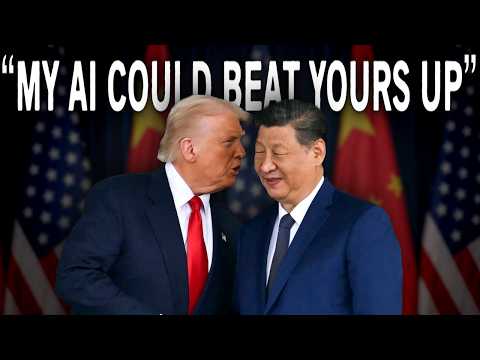
bUt wE cAn"T lEt cHinA WiN tHe AI aRmS rAcE!!

Video thumbnail: bUt wE cAn"T lEt cHinA WiN tHe AI aRmS rAcE!!
May 14, 202619m 26s video lengthHow Money Works

The Signal

American AI firms have rapidly expanded their Washington lobbying, spending over $100 million in the past year to influence policy through a consistent "China will win" narrative. While this framing warns of an existential arms race to justify deregulation, major companies are simultaneously lobbying for permissions to export their most advanced chips into China, raising questions about whether the industry’s strategic threat narrative is a sincere national-security posture or a selective tool for market access and subsidy acquisition.

The Case

  • OpenAI has significantly increased its lobbying presence while critics allege its founders and early investors funneled millions into a dark-money group, Build American AI, to recruit paid influencers and shape public opinion.5:39
  • Nvidia, which quintupled its lobbying spend, is actively seeking to export advanced H200 and H100 chips to China even as it warns regulators that China represents an existential competitive threat to the United States.0:20
  • While the industry uses the "beat China" argument to lobby against safety and liability rules, China has enacted its own extensive regulatory regime—including mandatory algorithm registration and content labeling—which the video asserts is more comprehensive on paper than current U.S. federal policy.16:38
  • Large-scale data center projects, such as the one proposed in Utah, are presented as suspicious leverage tactics; the transcript claims these builders lack the necessary capital and prioritize extracting energy subsidies and environmental exemptions over actual construction.2:42
  • Industry messaging is noted for its inconsistency, framing AI as "harmless" to avoid consumer liability before regulators while describing the same technology as "species-ending" when seeking government investment or emergency powers.9:15

The 1 Minute Signal Take

The evidence suggests the industry’s arms-race framing acts more as a lobbying pretext than a coherent strategic doctrine, particularly given the blatant contradiction between the demand for protectionism and the pursuit of chip exports. Watch this video for the pointed structural breakdown of how lobbying incentives shape the "China" narrative, but skip the secondary anecdotal segments about specific data-center speculators which add little to the core argument.

Pro Analysis

Strategic Significance:

The AI sector is successfully framing its commercial expansion as a matter of national security. By preemptively defining all regulation as a 'loss' in the global arms race, firms are insulating their growth from standard public interest oversight and environmental compliance, effectively privatizing the benefits of AI scaling while externalizing the costs.

Who Should Care:

  • Policymakers: To prevent the capture of regulatory bodies under the false pretense of national security.
  • Data Center Investors: To separate genuine, funded infrastructure projects from speculative announcements designed to extract local subsidies.
  • Tech Journalists: To map the 'dark money' pipelines and influencer networks that amplify industry talking points under the guise of grassroots activism.

Contrarian Takeaway:

A market-driven 'deregulation' strategy could actually leave the US less secure than a targeted, nuclear-style regulatory framework. By refusing to treat AI as a high-risk strategic technology—complete with supply-chain security and strict end-use tracking—the industry is sabotaging the very national security it claims to defend, prioritizing quick commercial scale over the deliberate, secure development required for genuine strategic dominance.

Time saved:16m 50s

Share this