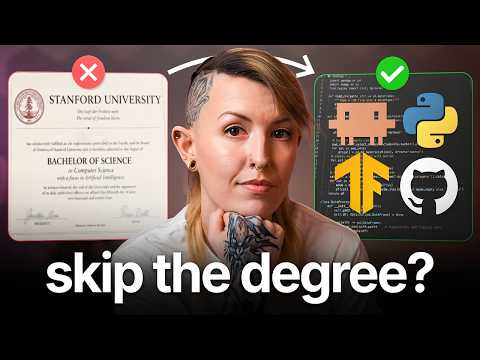
Can You ACTUALLY Get an AI Job Without a Degree? (The Honest Answer)

Video thumbnail: Can You ACTUALLY Get an AI Job Without a Degree? (The Honest Answer)
Jul 16, 20268m 8s video lengthMarina Wyss - AI & Machine Learning

The Signal

Whether an AI career requires a formal degree depends entirely on the role, as research positions remain heavily PhD-oriented while applied engineering roles increasingly value skill over credentials. Dropping degree requirements in job postings is a documented trend, yet data suggests this change is often cosmetic, rarely leading to actual diversity in hiring outcomes.

The Case

Career Credential Bar

  • Research scientist roles—those inventing new AI methods at top labs—remain deeply tethered to academia, with over 90% of these professionals holding a PhD.1:38
  • Applied AI engineering roles—the builders using RAG, agents, and prompting—also show high written barriers, with over 40% of listings requesting a master’s and 20% seeking a PhD.
  • AI automation roles, which involve wiring LLM APIs into business tools like Zapier, represent the least credential-focused path and are frequently freelance or entrepreneurial in nature.2:28

Hiring Mechanics and Reality

  • A Harvard Business School analysis of over 11,000 roles found that after firms removed degree requirements, the hiring of non-degreed candidates increased by fewer than one in 700, suggesting much of the policy shift is marketing.4:00
  • Automated resume screeners often prevent qualified candidates from being seen, with 88% of employers admitting they disqualify applicants who do not precisely match every criteria listed on the posting.6:28
  • Boot camps, while potentially useful for structure, offer mixed value; reported placement rates of 79% often count any employment as a success, and some providers have faced lawsuits over inflated statistics.4:33

Strategic Alternatives

  • For candidates without a degree, a portfolio consisting only of tutorial clones is weak evidence; success usually requires building a real, deployed project used by someone else, such as an app in the store or a tool for a local nonprofit.5:36
  • Blind online applications on platforms like LinkedIn are highly prone to rejection by automated filters, making personalized outreach to hiring managers or seeking direct referrals a necessary, if more difficult, workaround.6:54

The 1 Minute Signal Take

Do not treat the general job market’s move toward 'skills-first' hiring as a universal green light; it is a fragmented shift that largely ignores the automated filters currently blocking entry. If you are not in the research track, your best path to survival is bypassing blind application portals in favor of building tangible work used by real people.

Pro Analysis

Why It Matters

The transition from academic-led AI research to broader industry application has created a labor market mismatch where job descriptions are decoupled from actual job requirements. For candidates, this means the 'traditional' path is both the safest and potentially the least efficient investment of time.

Strategic Implications

Companies are incentivized to maintain high credential barriers to reduce the flood of applicants, even when those barriers aren't technically relevant. This creates a hidden market for 'side-door' applicants—those who understand how to leverage technical debt and small-scale automation to gain direct access to hiring managers.

Evidence & Hype Audit

The content relies heavily on Harvard Business School research to puncture the 'hiring revolution' myth. It is grounded, cynical, and avoids the common trap of over-promising on the efficacy of self-learning. The inclusion of sponsor segments for AI code-review tools is clearly marked and does not pollute the primary analysis.

Counterarguments

Critics might argue that degrees provide a necessary fundamental grounding in mathematics that 'tutorial-based' learners will never acquire. While true for foundational research, the 'applied' sector moves so quickly that the two-year lag of an academic degree could theoretically lead to an obsolescence of the very tools being taught.

Who Should Care

  • Hiring Managers: You are likely using filters that reject your best potential candidates.
  • Career Changers: Stop applying blindly; start building software that people actually use.
  • Students: Pursue a degree if you are aiming for research, but don't count on it as a 'golden ticket' in the applied engineering job market.

What to Do Next

  • Audit your portfolio for 'real-world' usage versus tutorial work.
  • Identify 5 specific companies you want to work for and map their key engineers.
  • Rewrite your resume to focus on deployments and project metrics, not credentials.
  • Research the specific hiring process of target firms to see if they utilize blind ATS filters.
  • Seek out professional networks rather than job boards.
Time saved:4m 32s

Share this

Tags

Written by: 1 Minute Signal Editorial Team