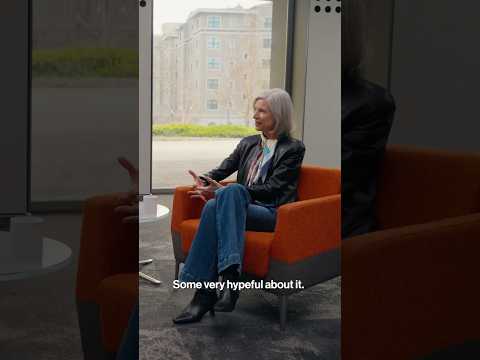
"Good luck." Jennifer Doudna on AI Drug Discovery Promises

Video thumbnail: "Good luck." Jennifer Doudna on AI Drug Discovery Promises
Jun 25, 20261m 9s video lengthBloomberg Originals

The Signal

An industry executive—speaking here on the utility of chatbots in fields like drug discovery—rejects the idea that OpenAI should automatically claim a share of sales from discoveries mediated by ChatGPT. The central tension pits aggressive promises of near-instant breakthroughs against the executive’s empirical, present-tense skepticism regarding AI’s capacity to generate genuinely novel ideas.

The Case

  • Present-day chatbot utility is limited to auxiliary tasks like summarizing data and writing reports, rather than true innovation, according to the speaker’s experience.0:32
  • The speaker dismisses the suggestion that OpenAI should earn revenue from discoveries simply because they involved the software, responding only with "Good luck."0:11
  • Claims that AI will cure cancer in a "48-hour window"—as recently touted by tech executive Larry Ellison—are treated as unsubstantiated hype rather than credible milestones.
  • The speaker explicitly distinguishes between today's limitations and future potential, noting that while they do not see innovation now, they "never say never" regarding the impact of future Artificial General Intelligence.0:50
  • The executive’s skepticism is self-reported and experiential, relying on current observations rather than a universal claim that AI can never be innovative.

The 1 Minute Signal Take

This is a grounding corrective to the hype cycle, distinguishing helpful administrative tools from genuine discovery engines. Skip the video; the summary covers the full substance of the executive’s pragmatic, wait-and-see posture.

Pro Analysis

Strategic Significance:

This discussion highlights the maturation of the AI hype cycle. As organizations move from experimentation to integration, the focus is shifting away from theoretical potential toward tangible output. The gap between AI's 'summarization' capability and 'innovation' capability is the critical frontier for future R&D valuation.

Who Should Care:

  • Venture capitalists needing to distinguish between 'AI-enabled' product features and core transformative innovation.
  • Corporate leaders deciding on licensing deals and revenue-sharing models for AI-mediated workflows.
  • Software architects managing expectations for what LLMs can achieve in deep-science fields like drug discovery.

Contrarian Takeaway:

True innovation in high-stakes fields may actually be hindered, not helped, by AI reliance. By defaulting to chatbot-generated summaries, human teams risk 'cognitive capture,' where they settle for the model's statistically likely conclusions rather than pushing toward truly novel, non-obvious scientific hypotheses.

Share this

Tags