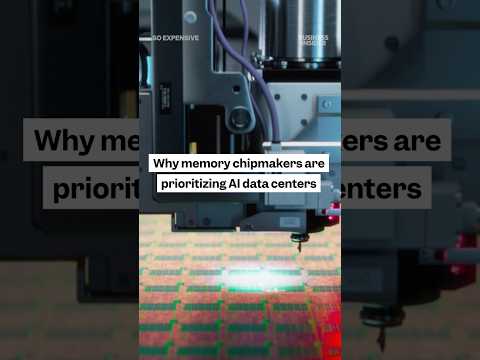
Why #AI is putting pressure on memory chip prices. #semiconductors #datacenters #soexpensive

Video thumbnail: Why #AI is putting pressure on memory chip prices. #semiconductors #datacenters #soexpensive
Sep 29, 20262m 7s video lengthBusiness Insider

The Signal

Micron, Samsung, and SK Hynix—who collectively control nearly 90% of global DRAM and 60% of NAND output—have redirected capacity toward high-bandwidth memory (HBM) to serve the explosive demand for AI data centers. This strategic pivot highlights a trade-off where the race for AI infrastructure may be driving up prices for standard consumer electronics memory.

The Case

Production Reallocation

  • Micron, Samsung, and SK Hynix have shifted at least some production capacity from standard NAND and DRAM toward HBM, which is the high-bandwidth variant needed for AI workloads.1:07
  • As these three firms hold an overwhelming share of the global memory supply, their individual production choices directly dictate market-wide inventory levels for both AI and consumer-grade hardware.
  • The transcript asserts that this intentional reduction in NAND and DRAM supply is the primary cause of the current "soaring" prices for those memory types, though this causal link is presented as a strong correlation rather than proven by direct pricing data.2:00

AI Infrastructure Scale

  • The intense focus on HBM is fueled by massive capital deployment; Google, Microsoft, Meta, and Amazon have reportedly spent over $1 trillion on AI expansion since 2023.1:43
  • Physical construction is mirroring this financial commitment, with 2,228 new data centers in planning or construction stages across the U.S. as of August 2026.
  • While the narrator frames AI as central to the U.S. economy—citing that 80% of stock gains this year came from AI-linked companies—this interpretation relies on selected indicators rather than a formal macroeconomic analysis.

The 1 Minute Signal Take

The memory-chip market is currently functioning as an extension of the AI infrastructure boom. While AI demand is demonstrably real and massive, users of standard NAND and DRAM should expect persistent supply-chain volatility as producers prioritize the more lucrative HBM market.

Pro Analysis

Why It Matters

The transition of core memory production toward AI-specialized HBM represents a structural change in the semiconductor industry. When the companies controlling 90% of the world's DRAM supply reorganize their factories to serve a single, massive customer segment (AI data centers), the downstream effects on consumer electronics and server supply chains are inevitable and systemic.

Strategic Implications

Businesses reliant on standard hardware are now effectively competing for the remaining scraps of production capacity. This suggests that the 'AI tax' is moving beyond compute costs and into the physical components of server and device architecture. Companies must treat memory as a strategic resource rather than a commodity.

Evidence & Hype Audit

While the transcript provides a coherent narrative regarding supply shifts, it is heavily reliant on assertive, high-level claims (e.g., '$1T in spending') that lack granular supporting data or third-party audit. The claim that AI is 'central to the US economy' is an interpretation, not an established fact, and should be viewed as industry-aligned rhetoric rather than detached analysis.

Counterarguments

Critics might argue that memory cycles are notoriously cyclical and that current capital expansion will lead to a supply glut once construction finishes. The 'soaring' price narrative may also be conflating AI-driven supply constraints with other macroeconomic factors like energy costs or general inflation.

Who Should Care

  • Hardware Procurement Managers: Need to hedge against long-term memory price hikes.
  • Technology Investors: Should monitor the 'AI spending' sustainability in upcoming quarterly reports.
  • Infrastructure Planners: Must account for longer lead times on memory-heavy server deployments.

What to Do Next

  • Conduct a supply chain audit to identify exposure to standard DRAM and NAND.
  • Establish longer-term vendor contracts to stabilize input costs for memory components.
  • Track the ratio of HBM to standard DRAM production in upcoming earnings calls for Micron, Samsung, and SK Hynix.
  • Analyze internal hardware lifecycle planning to prioritize upgrades in lower-memory-consumption environments.
  • Monitor publicly available data-center construction permits as a leading indicator of regional demand spikes.

Share this

Tags

Written by: 1 Minute Signal Editorial Team