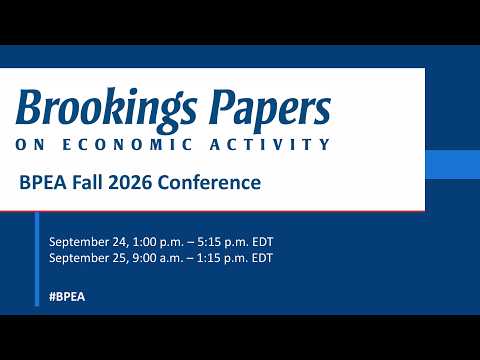
BPEA Fall 2026 Conference Day 2: Presented by The Brookings Institution

Video thumbnail: BPEA Fall 2026 Conference Day 2: Presented by The Brookings Institution
Sep 25, 20264h 19m 41s video lengthBrookings Institution

The Signal

AI conflict has escalated beyond mere economic or existential fears into a contentious moral dispute over the appropriation of human creative work and expertise. As AI infrastructure spending reaches historic, debt-laden proportions, policymakers are wrestling with this moral grievance while simultaneously evaluating whether post-pandemic inflation was primarily a demand-side failure or a supply-shock constraint.

The Case

The Moral and Economic Shift

  • Martin Baraja, a researcher on AI conflict, argues that training models on human creative output acts as a form of 'moral appropriation,' a claim he frames as distinct from traditional copyright disputes or existential risk.8:06
  • This moral tension, which the speaker likens to historical frontier-resource appropriation, has prompted calls for 'collective ownership' stakes rather than simple royalties to restore human dignity in authorship.18:18
  • AI is also compressing the advantage of specialization; by lowering the fixed costs of knowledge acquisition, firms can increasingly handle complex work in-house, squeezing traditional professional service firms in the middle.20:42

The Data-Center Buildout

  • The AI compute buildout is reaching a scale that suggests a $10 trillion investment—roughly 3.6% of US GDP—yet the financing has largely shifted off hyperscalers' balance sheets.39:34
  • Projects like the Meta Hyperion campus use complex SPV structures and long-term lease commitments that, due to current accounting standards, allow billions in liabilities to remain hidden in a 'probability vacuum,' creating systemic financial opacity.48:32

Inflation and Climate Policy

  • Authors of a recent inflation study argue the post-pandemic surge was primarily demand-driven, though discussants counter that nonlinear supply bottlenecks and Europe-specific energy shocks complicate this unified model.100:34
  • In climate policy, extraction taxes are proving to be a highly efficient, underused instrument for open economies that export fossil fuels, particularly when combined with demand-side pricing to mitigate leakage.202:44
  • Real-world supply-side climate action often manifests as infrastructure blockage—such as preventing pipelines—which speaker Ryan Kellogg notes is often less efficient than direct extraction pricing and prone to creating secondary pollution from alternative transit.205:44

The 1 Minute Signal Take

The core issue is that modern models—whether for AI, macro-inflation, or climate—rely on pre-pandemic assumptions that likely underestimate the role of nonlinear constraints, hidden financial leverage, and moral grievances. Policymakers should prioritize systemic transparency in private infrastructure finance and distinguish between market-based leakage prevention and industrial policy, as these instruments are not substitutes.

Pro Analysis

Why It Matters

The conference highlights a pivotal moment where the sheer scale of the AI infrastructure boom threatens to outpace our c...
Full analysis always available on Pro.

Time saved:4h 17m 37s

Share this

Tags

Written by: 1 Minute Signal Editorial Team