
Channel: Theo - t3․gg
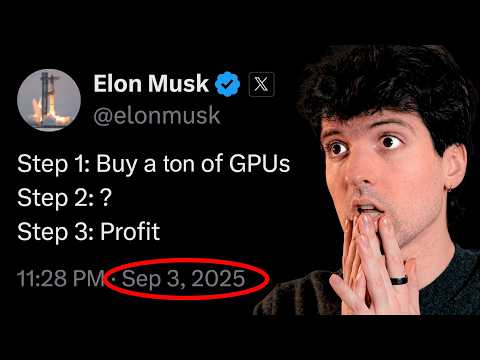
Elon won after all
The Signal
AI infrastructure is currently defined by a stacked supply-chain bottleneck where hardware scarcity at the fab, memory, storage, and power levels creates artificial and real service ceilings. While compute demand is largely considered settled, the claim that every player is universally constrained remains contested; the central tension instead lies in whether these multi-year infrastructure lag times will permanently shift industry competitive dynamics or merely define interim market pricing.
The Case
- Microsoft and Google, the two largest cloud providers, both cite active supply constraints on capacity, settling that even massive capital injection has not yet solved existing hardware bottlenecks.
- Anthropic, a leading AI model developer, and Google are currently paying xAI and SpaceX approximately $1 billion and $920 million per month respectively to rent spare compute, highlighting the extraordinary monetization of early over-purchased assets.
- TSMC, the Taiwanese semiconductor giant that services nearly all major logic chip designers, estimates that new fabrication capacity takes 8 to 10 years to build, introducing ironclad inertia into any supply-side recovery.
- Memory supply for AI is being prioritized over consumer electronics, exemplified by Micron's wind-down of its Crucial consumer brand to redirect production toward high-bandwidth datacenter demand.
- Storage availability is a secondary but major constraint, with Western Digital reporting that its supplies are effectively sold out through 2026, forcing GPU users to wait on drive availability to deploy functional arrays.
- Power grid capacity is a binding limit for high-intensity compute, with commercial/industrial electricity demand projected to surpass residential use in 2027, forcing large compute buyers to aggressively pursue utility and nuclear investments.
- NVIDIA, the dominant supplier of AI GPUs, remains the sector's primary beneficiary because its chips are the central node of the stack; any upstream easing of bottlenecks directly translates to higher NVIDIA sales.
The 1 Minute Signal Take
The video moves beyond general tech hype to accurately detail the physical stack limits—silicon, memory, archival storage, and grid power—that currently govern AI growth. It correctly flags the irony of Google and Anthropic funding a competitor's build-out via compute rental, though its totalizing conclusion that Nvidia is the 'only' winner leans on overconfident forecasting. Watch this for the specific economic figures regarding compute-rental costs and the industrial data points on power shift, but you can skip the corporate narrative framing.
Time saved:
Tags
Channel: Theo - t3․gg