
Back to Feed
I hate that this is true
The Signal
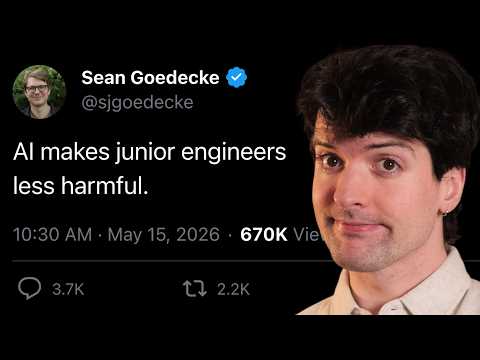
AI is significantly widening the performance gap between software engineers, acting as a force multiplier for motivated learners while enabling stagnation for the unmotivated. While AI models can raise the floor for weak output, preventing catastrophic coding errors, the central dispute remains whether this assistance fundamentally helps junior talent grow or merely masks a lack of foundational understanding. The speaker argues that engineering effectiveness is defined less by headcount—often harmed by coordination overhead—than by the ability to manage scope and retain high-taste, high-motivation contributors.
The Case
- AI tools like Claude Code can raise the performance floor by steering weak engineers toward better technical decisions and catching obvious errors like infinite loops or data leaks.
- Engineering performance is highly bifurcated: motivated juniors accelerate their growth by using AI as an 'infinite learning machine,' whereas lazy users may rely on it to substitute for critical thinking, worsening their technical deficit.
- A disastrous blog deployment at ModView, involving multiple failed attempts to host simple videos—including massive GIF conversions and incorrect embed code—was cited as proof that isolated engineers can persistently make poor technical choices without intervention.
- Attempting to speed up late projects by adding more engineers often backfires, creating onboarding and orchestration burdens that slow production, a phenomenon the speaker treats as an established principle.
- Strong engineers frequently become frustrated by lower-quality teammates, leading to retention issues; companies often perform better with small, highly-paid teams than large groups that require excessive management.
- The speaker’s 'dumb questions rule,' which mandates that new hires ask one naive question daily, successfully fostered rapid development in junior engineers like Mel, who grew quickly by tackling high-context projects.
- The speaker asserts the 'bottom 30%' of engineers face an increasingly volatile career outlook, though this prediction lacks external validation and relies on a personal, non-systematic definition of engineering quality.
The 1 Minute Signal Take
The speaker delivers a rigorous, if occasionally overconfident, breakdown of how AI shifts the engineering power dynamic in favor of high-agency talent. It effectively dismantles the idea that AI is a universal equalizer, skewering the myth that adding heads is a solution for late projects. Watch it for the vivid, case-study-level detail on the ModView workflow disaster, which serves as a masterclass in how small-scale technical incompetence can sink substantial organizational resources.
Time saved:
Back to Feed