
- AI is best viewed as 'augmented intelligence' to boost employee capability.
- Predictions about AI permanently ending professional careers have historically proven inaccurate.
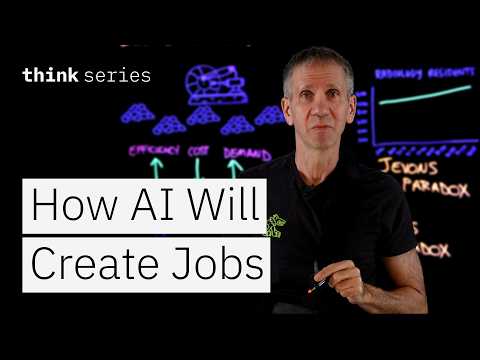
- Jevons Paradox dictates that efficiency lowers the barrier to entry, sparking increased demand for services.
- The rise of AI necessity has introduced new roles like safety and prompt engineering.
- Automation shifts human labor from routine tasks to high-discretion, high-accountability functions.
- The human-in-the-loop is essential for decision-making and ethical governance.
- Companies focusing solely on staff reduction will miss the opportunities provided by new AI use cases.
- Adaptability and the ability to learn are the most critical skills for the modern professional.
How Smart Organizations Will Use AI: Jevons Paradox & Workforce Impact
IBM Technology
The video argues that AI adoption will not lead to mass job extinction, but will instead trigger a growth cycle where increased efficiency lowers costs and drives demand for higher-order human roles.
Key Takeaways
- Organizations that thrive focus on strategic growth and innovation via technology rather than just cost-cutting measures.
- Using Jevons Paradox, the presenter demonstrates that increased efficiency leads to lower costs, which in turn spikes demand rather than reducing it.
- History shows that technological advancements—from steam engines to spreadsheets—have consistently created more complex jobs rather than eliminating human labor.
- Future workforce success depends on adaptability, critical thinking, lifelong learning, and the uniquely human ability to provide context and governance to AI systems.
Talking Points
Pro Analysis
Strategic Importance
The premise offered here is a vital antidote to the pervasive 'AI-apocalypse' anxiety that dominates corporate discourse. Strategically, it shifts the conversation from defensive (layoffs) to offensive (innovation). Organizations that view AI as a replacement tool will stagnate, while those that view it as a productivity engine to expand their services will likely capture the next market wave.
Who Should Care?
Leadership teams and individual contributors alike should care about this shift. Managers must understand that AI provides the capacity for their teams to tackle higher-value projects. Employees should recognize that their 'job security' is no longer about technical proficiency in a specific task, but about their ability to provide the human 'meaning' or decision-making context that AI lacks.
Contrarian Takeaway
The most counter-intuitive point is that increased efficiency often leads to an explosion of work rather than a reduction. While standard intuition suggests that AI saves time, the economic result is that we simply find more complex, resource-heavy problems to solve once the low-hanging fruit has been automated. Consequently, the bottleneck in the future economy will not be technical ability, but the scarcity of qualified humans who can manage, oversee, and orchestrate the output of intelligent systems.
Time saved:
Written by: 1 Minute Signal Editorial Team