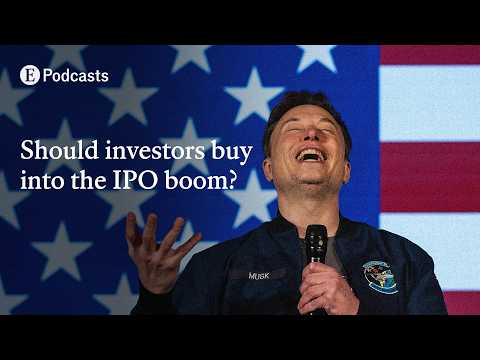
What SpaceX, OpenAI and Anthropic's IPOs mean for investors | The Economist

Video thumbnail: What SpaceX, OpenAI and Anthropic's IPOs mean for investors | The Economist
Jun 6, 20267m 28s video lengthThe Economist

The Signal

A looming wave of "giga IPOs" from SpaceX, OpenAI, and Anthropic is being framed by market observers as a potential landmark shift in capital markets. The core tension lies in whether these listings represent a bubble-top sell-off by private investors or a legitimate new structural phase for public indices, with debate centering on the impact of forced index inclusion on passive retirement savers.

The Case

  • Institutional risk is less about the $75 billion SpaceX raise, which would represent roughly 0.1% of the S&P 500, and more about the speed of index entry; some providers are reportedly fast-tracking newly listed firms into indices as soon as 5 days after their debut.1:11
  • Historical data from Jay Ritter, an academic at the University of Florida, suggests that IPOs tend to underperform the broader market by 20 percentage points over a three-year window, a pattern that observers argue is exacerbated when firms are priced at aggressive valuation multiples.3:33
  • SpaceX is characterized as a particularly extreme case by the speaker, carrying a projected $1.75 trillion valuation that sits at 90 times annual sales, requiring speculative future business lines to justify current entry prices.5:11
  • The transcript notes a broader reversal in corporate capital flow: tech giants appear to be pivoting from returning cash via buybacks to absorbing capital through bonds and follow-on equity offerings.6:44
  • While the speaker warns this transition could weigh on future market liquidity, they categorize these concerns as unsettled, acknowledging these firms could alternatively grow into their valuations if their long-term business trajectory is truly transformative.7:11

The 1 Minute Signal Take

The video effectively challenges the common assumption that high-profile IPOs are winners by default, focusing heavily on the mechanics of index-fund vulnerability. Skip it if you are already familiar with IPO underperformance trends; watch it if you want to understand how index-tracking institutional changes are creating new, automated volatility for individual retirement accounts.

Pro Analysis

Strategic Significance:

  • This event signals a fundamental shift in how big tech consumes capital and how passive indexing impacts market liquidity. The conversion of capital-rich tech giants into capital-hungry entities changes the supply-demand balance of the entire market.

Who Should Care:

  • Passive investors and retirement savers are the most vulnerable, as they are being forced into volatile, early-stage public equities through index rebalancing they never explicitly approved.

Contrarian Takeaway:

  • Large-scale index inclusion is evolving from a mechanism of stability into one of the largest sources of short-term systematic volatility because it forces institutions to buy at the peak of 'hype' valuations.
Time saved:5m 18s

Share this

Tags

Written by: 1 Minute Signal Editorial Team