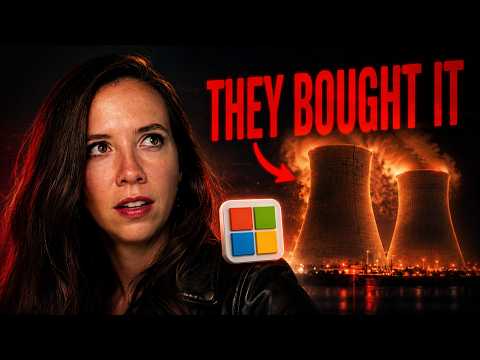
AI's $2 Trillion Problem Just Hit Your Electric Bill

Video thumbnail: AI's $2 Trillion Problem Just Hit Your Electric Bill
Aug 7, 202611m 4s video lengthJulia McCoy

The Signal

AI infrastructure is driving an unprecedented surge in electricity demand, forcing tech giants to bypass the struggling electrical grid by financing their own nuclear power. As data centers scramble to secure energy, the resulting strain on residential prices and local grids has triggered political backlash, creating a tense competition between private AI expansion and public energy affordability.

The Case

The Grid Bottleneck

  • The U.S. interconnection queue for new power projects has swelled to over 2,600 gigawatts, with an average five-year wait and an 80% project withdrawal rate, forcing hyperscalers to self-supply to keep pace with AI deployment.4:50
  • Data center electricity demand is projected to more than double globally by 2030 to 945 TWh, accounting for nearly half of all projected electricity demand growth in the United States over the same period.1:14

Corporate Nuclear Strategy

  • Major tech firms are bypassing grid delays through massive nuclear investment, such as Microsoft’s $1.6 billion, 20-year agreement to restart the Three Mile Island Unit 1, which will dedicate its 835-megawatt output exclusively to its data centers.2:39
  • Hyperscalers have announced at least 13 nuclear-related deals totaling roughly 9.8 gigawatts and $50 billion in capital, ranging from small modular reactor partnerships by Google and Amazon to Meta’s multi-vendor commitments.3:57

Local Impact and Pushback

  • Public resistance is rising as data center growth contributes to sharp residential rate hikes, evidenced by a Gallup survey showing 70% of Americans oppose local data center construction and the recent blocking or delay of 75 projects worth approximately $130 billion.5:57
  • An illustrative case in Manassas, Virginia, shows a resident’s monthly electric bill jumping from roughly $100 to $281 in a single year, highlighting the political pressure on officials to ensure AI infrastructure pays its own way rather than shifting costs to ratepayers.0:22

Future Tech Limits

  • While quantum computing demonstrates extreme efficiency for specialized simulation and grid-stability tasks, it cannot currently train or run language models and is not expected to displace the data center buildout within this decade.8:19

The 1 Minute Signal Take

The tension lies in whether private energy procurement by big tech will provide a path to a more robust, modern energy grid or merely serve as a private enclave that leaves the public to subsidize the rising costs of an AI-driven society. Quantum and fusion solutions remain speculative in the near term, meaning the current nuclear-restart strategy is the primary mechanism for decoupling AI growth from grid bottlenecks.

Pro Analysis

The Power Paradox

This narrative highlights a classic structural conflict: the rapid expansion of a high-value private industry (AI) requires utility-level resources that are currently constrained by rigid, public-facing regulatory frameworks.

Strategic Implications

  1. Vertical Integration as Survival: Hyperscalers are moving toward complete energy vertical integration. Companies that do not control their own power generation will likely face 'compute rationing' dictated by grid availability.
  2. Energy as a Competitive Moat: Future AI supremacy will not be defined solely by parameter counts or training datasets, but by the ability to secure gigawatt-scale, 24/7 carbon-free energy without triggering populist political backlash.

Evidence & Hype Audit

  • Hype Check: The quantum computing claims remain 'future-dated.' While the D-Wave simulation example is impressive, the prompt admits that quantum will not displace current architectures this decade.
  • Trustworthiness: The data on grid interconnection and nuclear deals is concrete and well-cited. The 'Manassas bill' anecdote is the weakest link; it functions as an emotional hook rather than rigorous statistical proof of causality.

Counterarguments

  • The Economic Catalyst View: Proponents argue that the massive investment from tech giants will modernize the grid and lead to lower long-term marginal costs for everyone, eventually creating a 'grid of abundance' rather than one of scarcity.

Who Should Care

  • Utility Investors: Must account for the shift from traditional rate-based returns to direct corporate power purchase agreements.
  • Tech Strategy Leads: Should prioritize energy site selection above compute-latency considerations.

What to Do Next

  • Audit the specific power mix of your compute provider.
  • Monitor local and state-level policy on 'data center rate subsidization.'
  • Diversify energy risk by backing providers with direct generation capacity.
  • Demand transparency from vendors on their energy procurement models.
  • Factor 5-year 'grid-delay risk' into all large-scale infrastructure deployment roadmaps.
Time saved:7m 29s

Share this

Tags

Written by: 1 Minute Signal Editorial Team