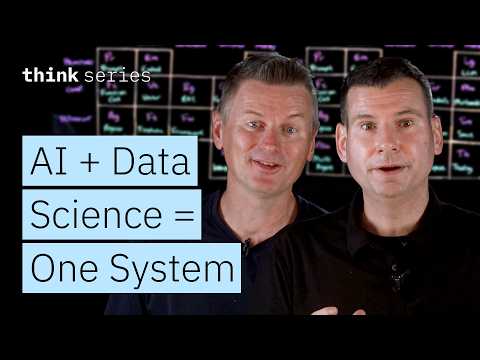
AI & Data Science Periodic Tables: How They Work Together

Video thumbnail: AI & Data Science Periodic Tables: How They Work Together
Aug 13, 202613m 21s video lengthIBM Technology

The Signal

Modern AI systems and data science work are increasingly inseparable, forming a reciprocal feedback loop. Data science prepares operational data for AI, while AI models help automate data labeling and synthetic training generation. This dependency means that enterprise AI quality is tethered to the underlying governance, cleaning, and freshness of the source data.

The Case

  • Enterprise AI pipelines function as a multi-stage feedback loop, not a linear process; AI now uses synthetic data and automated labeling to refine the very data preparation that originally powered it.0:49
  • A critical constraint in enterprise document Q&A is preventing permission leaks, where a system might inadvertently surface documents a user is not authorized to view; governance and source-grounding citations are mandatory to mitigate this.5:18
  • The risk of hallucination and relevance decay is exacerbated by stale information, making weekly data ingestion essential for pipelines dealing with volatile internal assets like corporate policy documents.6:08
  • Reliability is managed through a drift-detection loop: when query distributions shift or user feedback flags failures, the system generates synthetic question-answer pairs to fine-tune embedding models and re-align retrieval behavior. ### Learning Frameworks11:07
  • The speakers propose two unofficial "periodic tables" to organize these concepts, mapping data science maturity against functional columns and AI building blocks against lifecycle stages.
  • These frameworks treat complex systems like Retrieval Augmented Generation (RAG) as a combination of modular data elements—like metadata tagging and governance—and AI primitives such as embeddings and vector search.3:30

The 1 Minute Signal Take

The real-world performance of an enterprise AI agent is less about the model's raw generative capability and more about the robustness of the data governance and feedback loops surrounding it. These periodic tables are useful conceptual tools for mapping system dependencies, provided you view them as educational abstractions rather than exhaustive technical standards.

Pro Analysis

Why It Matters

The transition from experimental AI to robust enterprise utility depends on the reliability of the data pipeline. This video bridges the gap by treating AI not as a magic box, but as the final stage of a rigorous data engineering sequence, highlighting how systemic errors (like hallucinations) are often rooted in poor data preparation.

Strategic Implications

Organizations should stop viewing AI and data science as disparate departments. By adopting a feedback-loop architecture, companies can shift from manual model maintenance to automated, drift-aware systems that evolve alongside internal policy changes.

Evidence & Hype Audit

The content provides a clear, high-signal architecture for a common enterprise use case. While the 'periodic tables' are purely subjective frameworks, they effectively organize complex concepts. Note that the 'self-improving' loop is a design proposal; in practice, automating fine-tuning requires extreme caution regarding data quality to avoid 'model rot' or bias amplification.

Counterarguments

Critics might argue that embedding retrieval and synthetic Q&A loops add unnecessary architectural complexity. For many businesses, a well-implemented vector search without the overhead of automated synthetic feedback may be sufficient and far easier to maintain.

Who Should Care

  • Data Engineers: To understand how their pipeline output impacts LLM performance.
  • AI Architects: To design systems that prioritize governance and grounding.
  • Enterprise IT Managers: To evaluate the feasibility of deploying proprietary AI on internal document stores.

What to Do Next

  • Audit your current data pipelines for 'stale-data' risks in policy-driven environments.
  • Map your existing AI stack against the functional groups discussed to identify missing governance components.
  • Implement source-citation requirements in your prompt templates to force grounding.
  • Start monitoring embedding drift as a lead indicator for retrieval quality degradation.
  • Pilot a small-scale synthetic generation project to improve specific, high-frequency query failures.
Time saved:10m 18s

Share this

Tags

Written by: 1 Minute Signal Editorial Team