
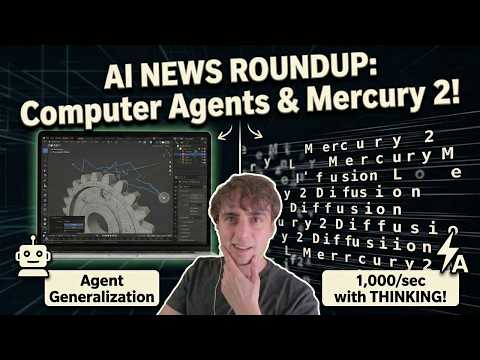
- AI models are transitioning from static text processing to active computer use via video-trained agents.
- Long-context video encoders allow AI to understand and replicate complex desktop workflows that were previously impossible.
- Mercury 2 leverages diffusion technology to output text at massive speeds, challenging standard auto-regressive benchmarks.
- The rise of handcrafted, small-parameter models reveals that extreme efficiency can lead to high accuracy in specific logic tasks.
- Nvidia's Sonic model uses human motion-capture data as a primary trainer for robotic movement.
- Simulation tools like Isaac Lab provide a massive multiplier for robotic training speed, allowing years of experience in mere hours.
- The convergence of AI, GPUs, and robotics is creating a cycle of development that incentivizes further hardware investment.
I Watched an AI Drive a Real Car Through San Francisco Using Arrow Keys
MattVidPro
Key Takeaways
- New computer-use models are moving beyond simple text prompts to operate complex desktop software like CAD and Blender by interpreting video inputs.
- Diffusion-based language models are emerging as a high-speed alternative to traditional auto-regressive models, enabling near-instant token generation.
- Robotics is undergoing a paradigm shift where foundation models facilitate whole-body control, significantly reducing the need for hand-coded movement scripts.
Talking Points
Pro Analysis
The content highlights a strategic pivot in AI development: moving from 'chat-based' intelligence to 'action-based' intelligence. This is critically important for enterprise leaders as it shifts AI from a helpful research assistant to a deployable operational worker that performs tasks within existing software ecosystems.
Key Strategic Takeaway: The reliance on 'motion-capture' data for robotics mirrors the paradigm shift currently happening in software automation—we are training machines by showing them how we behave, rather than writing explicit instructions for them to follow.
Contrarian Thought: While the buzz surrounds large, compute-heavy models, the most efficient and impressive results are increasingly coming from tiny, purpose-built, handcrafted models. This suggests that the 'bigger is better' era of LLMs may eventually be supplanted by highly efficient, specialized 'tiny' models that out-perform generalists in production environments. Organization leaders should focus less on chasing the largest parameter counts and more on finding the right model-to-task fit, which will slash costs and increase reliability.
Time saved:
Written by: 1 Minute Signal Editorial Team