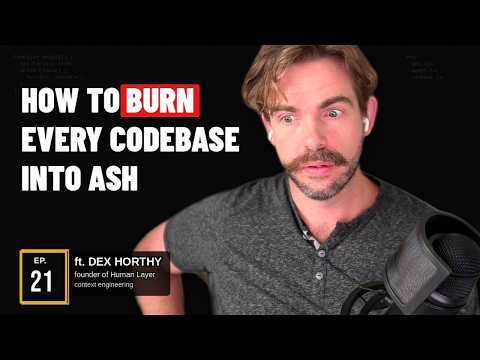
What Actually Gets You 2-3x With AI Coding (ft. Dex Horthy)

Video thumbnail: What Actually Gets You 2-3x With AI Coding (ft. Dex Horthy)
Aug 13, 20261h 39m 13s video lengthJan-Niklas Wortmann

The Signal

AI is a leverage tool for software engineering, but it requires deliberate human steering to be effective in production environments. The core tension lies between the seductive potential of 10x automation claims and the reality that shipping quality software remains a craft dependent on planning, human code review, and systematic design.

The Case

Practical Engineering

  • High-stakes production software realistically sees a 2-3x throughput increase with AI, not the 10x or 100x gains often touted in hype cycles.0:29
  • The most dangerous failure mode is "shipping slop"—prioritizing speed over architectural integrity, which can cause a codebase to collapse into unmaintainable debt.0:52
  • Engineering managers and individual contributors must distinguish between "vibe coding"—acceptable for low-stakes prototypes and internal tools—and enterprise production, which demands rigorous code review and design validation.23:06

Operational Workflow

  • Effective context engineering involves manually shaping what enters the context window; existing automated abstractions are not yet reliable enough to replace direct human control.
  • Planning artifacts should be tactical and disposable; a spec that attempts to dictate every line of code becomes a rigid, unmaintainable burden rather than a useful guide.29:48
  • When review processes routinely consume hours, the fault lies in the PR size or the underlying process, not the reviewer; AI-powered review bots should serve only as a baseline filter, not a final quality gate.20:43

The Future of IDEs

  • The next generation of development environments will move beyond the text pane to prioritize a collaborative control surface that exposes agent sessions, diffs, traces, and design artifacts as first-class objects.89:05
  • Subagents are most valuable for parallelizable, read-only work—like debugging loops or CI log processing—which helps keep the main context window focused and manageable.64:45

The 1 Minute Signal Take

AI is not a replacement for fundamental engineering discipline; it is a mechanism to amplify human intuition and design taste. Success depends on treating AI as a collaborative agent within a well-governed factory, rather than an autonomous generator that obviates the need for code reading and systems thinking.

Pro Analysis

Why It Matters

This content serves as a reality check against the "AI will eliminate software engineering" narrative. By grounding the potential of AI in the realities of production-grade engineering, it provides a pragmatic framework for leaders who need to deliver value without destroying their codebase integrity.

Strategic Implications

Organizations should pivot from chasing "10x" illusions to optimizing for "leveraged" workflows. This means investing in infrastructure that allows agents to be audited, visualized, and steered. The strategic goal is to build a development culture where AI serves the engineering process, rather than the engineering process being warped to accommodate AI limitations.

Evidence & Hype Audit

Dex Horthy’s claims are highly experiential and lean on a "software factory" mental model. While he avoids hard data or citations, his arguments are internally consistent and reflect common patterns seen in high-performance engineering teams. The skepticism toward public benchmarks is a high-signal indicator of a professional perspective rooted in real-world constraints.

Counterarguments

Critics might argue that the 2-3x ceiling is a temporary limitation imposed by current model architectures. If models evolve toward higher reasoning capacity and better internal world modeling, the need for current "context engineering" may diminish, and the productivity ceiling might shift upward significantly.

Who Should Care

  • Engineering Managers: To align expectations and avoid burnout from hype-driven speed targets.
  • Senior Engineers: To refine their own workflows and develop institutional knowledge on agent steering.
  • Platform Teams: To build the "post-IDE" tooling that will actually make agents productive in shared environments.

What to Do Next

  • Conduct an internal audit of your current code review process; if it takes longer than an hour, analyze why.
  • Formalize a "vibe coding" vs. "production coding" distinction in your team's internal guidelines.
  • Create a shared space (e.g., a Slack channel) for team members to exchange successful prompt patterns.
  • Experiment with subagents for your most tedious log-heavy CI tasks.
  • Archive project plans as soon as features ship to avoid maintenance bloat.
Time saved:1h 35m 50s

Share this

Tags

Written by: 1 Minute Signal Editorial Team