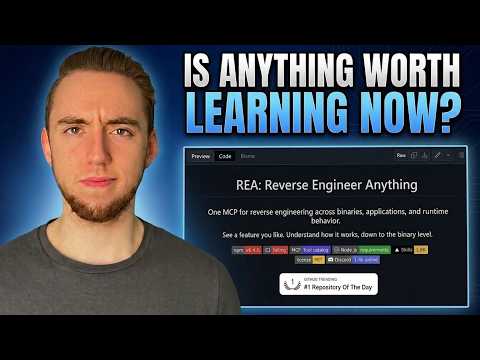
Is Learning to Build Software Still Worth It with AI? (My Honest Take)

Video thumbnail: Is Learning to Build Software Still Worth It with AI? (My Honest Take)
Oct 12, 202615m 58s video lengthCole Medin

The Signal

Viral claims that AI agents have "solved" coding because of a high-performing reverse-engineering repository overlook a critical distinction: the target application is already a complete specification. This suggests that current agent success depends less on raw model capability and more on the human's ability to provide concrete intent, references, and validation harnesses.

The Case

  • The reverse-engineering repo succeeds because the target application is literally the intent, allowing the agent to continuously validate against an existing product rather than abstract requirements.4:27
  • The speaker's attempt to build a 3D game failed repeatedly until he abandoned abstract descriptions in favor of a concrete visual reference, specifically the graphics style of a "Zelda" title.10:01
  • Engineers are shifting from direct codebase manipulation to "harness engineering," where the primary work is building the plans, sub-agents, and validation loops that constrain the agent.14:37
  • Old-school prompt engineering, such as crafting oversized rule files or specific linguistic tricks, has significantly declined in value as models improve at internalizing workflows.13:02
  • Blindly relaying requests from stakeholders to agents and back—the "meat proxy" approach—is a failure mode because the agent lacks the context to handle nuance without human planning.2:46
  • The Alexandria knowledge library, provided by the search company Firecrawl, integrates with coding agents like Claude Code to retrieve technical data from over 100 providers via the Model Context Protocol.7:05

The 1 Minute Signal Take

Do not mistake current agent performance on reference-rich tasks for general engineering automation. Your value is no longer in writing syntax, but in your ability to define the intent and build the harness that ensures the agent hits the target.

Pro Analysis

Why It Matters

This content marks a transition in the software industry from 'coding-centric' development to 'intent-centric' orchestration. It provides a necessary reality check for the 'AI replaces all programmers' narrative by distinguishing between self-specifying tasks and real-world ambiguity.

Strategic Implications

The shift toward 'harness engineering' suggests that the value of future developers lies in architectural literacy and system design. Organizations should pivot their training from syntax mastery to workflow orchestration and validation design.

Evidence & Hype Audit

The content relies heavily on personal anecdotes and qualitative observations. While the speaker acknowledges this limitation, the claims regarding 'prompt engineering decay' are highly subjective and may not hold true for all model architectures or domain-specific tasks. The inclusion of the Firecrawl/Alexandria demo is a transparent sponsor segment but serves as a relevant example of agent-accessible knowledge retrieval.

Counterarguments

Critics might argue that delegating coding entirely to agents creates a 'black box' problem where developers lose the ability to audit or debug the underlying architecture. Over-dependency on harnesses may also hide systemic flaws that only deep-level coding expertise could diagnose.

Role-Specific Takeaways

  • For Senior Engineers: Focus on building reusable agent templates and validation frameworks.
  • For Junior Engineers: Prioritize learning the fundamentals of software design, as agents will need human guidance to structure complex systems correctly.

What To Do Next

  • Audit your current workflow to identify where you act as a 'proxy' and replace that with a structured validation step.
  • Experiment with using concrete references (images, legacy code, or docs) as direct input for agent tasks.
  • Adopt the 'next model is twice as good' test to prune obsolete skills from your learning roadmap.
  • Invest time in learning how to design robust PRDs that act as the primary 'intent' source for your agent factory.
Time saved:13m 4s

Share this

Tags

Written by: 1 Minute Signal Editorial Team