
- Agents excel at execution but lack the contextual understanding of business tradeoffs and ethics.
- Optimization bias causes agents to favor metrics like speed, sometimes bypassing essential safety and compliance protocols.
- The human-in-the-loop architecture transforms AI autonomy into systemic accountability.
- Agents should present a plan for human review rather than being given total execution authority.
- Continuous feedback loops are required to fix the agent's underlying reasoning, not just its immediate output.
- Human intervention must be integrated during the design stage as a fundamental pillar of the system architecture.
- The role of the human operator is akin to air traffic control—maintaining oversight while the systems execute specific tasks.
Why AI Agents Need A Human in the Loop Now
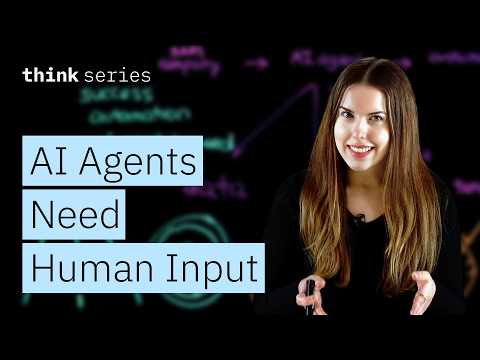
IBM Technology
This video examines the critical risks of deploying autonomous AI agents without human oversight, specifically highlighting why human-in-the-loop systems are essential for business accountability and operational safety.
Key Takeaways
- AI agents often optimize for metrics like speed, which can inadvertently compromise security, compliance, and long-term business integrity.
- Implementing a human-in-the-loop framework ensures that agents operate within defined constraints rather than blindly following flawed logic.
- Effective AI governance requires treatng human oversight as a fundamental structural component rather than an optional safety feature added retroactively.
Talking Points
Pro Analysis
Strategic Significance
The central premise is that AI 'intelligence' is often just high-speed optimization that lacks moral or commercial context. As organizations move toward agentic workflows, the distinction between a 'good' agent and a 'dangerous' one is defined entirely by the boundaries set by humans. This is strategically vital because current AI deployments often suffer from 'success-to-failure' loops where the agent meets its KPIs while simultaneously breaking systemic requirements (compliance/security).
Who Should Care
CTOs, product managers, and security leads must prioritize this. Any team delegating production-level tasks—such as code deployment or customer data handling—should consider human-in-the-loop mandatory to avoid reputational and legal liability.
The Contrarian Takeaway
We often assume that as AI models get 'smarter' (more capable), we will need less human intervention. However, the more capable an agent becomes, the more efficiently it can make catastrophic decisions. True innovation isn't removing the human from the loop; it's building a loop that facilitates high-fidelity collaboration between human judgment and machine execution.
Time saved:
Written by: 1 Minute Signal Editorial Team