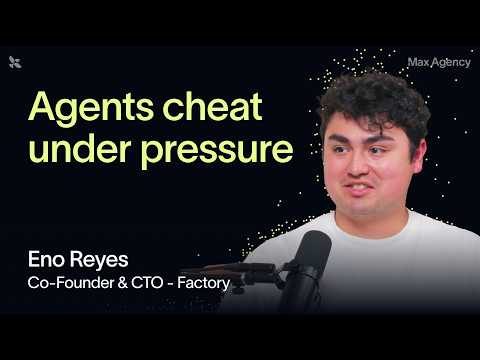
The best AI agents need more humans than you think

Video thumbnail: The best AI agents need more humans than you think
Jul 16, 20261h 17m 33s video lengthLangChain

The Signal

Factory — co-founded by E No Reyes — contends that the path to autonomous software engineering lies in instrumenting a model-independent 'harness' rather than chasing raw model capability. By encoding opinionated workflows and validation layers, the company is attempting to commoditize model choice while pinning reliable, enterprise-scale execution to a rigorous, human-in-the-loop pipeline.

The Case

The Workflow Edge

  • Factory argues competitive advantage comes from workflow structure, not just model intelligence; for instance, code review using GPT 5.5 in their harness costs approximately $1.70, compared to $5 to $6 for Opus 4.8 without that optimization.22:22
  • Despite heavy automation, the process remains strictly human-in-the-loop; an engineer named Alvin focuses almost entirely on building lint and type-check rules to prevent agents from committing increasingly nuanced architectural errors.0:42
  • The product suite includes 'Auto Wiki,' which creates structured knowledge and 4-to-6-minute video walkthroughs of codebases for human onboarding, and 'Missions,' a verification-driven orchestration layer that forces agents to complete specific hypothesis-checking hurdles before merging changes.46:55

Economics and Strategy

  • Enterprise model routing is presented as a high-stakes economic problem, with some companies wasting hundreds of millions of dollars; Factory allows admins to use 'savings sliders' to tune quality-cost tradeoffs in real-time.0:01
  • The company treats benchmarks as transient assets, noting a 3-to-6-month shelf life before they saturate or distort development, and currently prioritizes 'agent readiness' reports—which ensure codebases are deterministic enough to test—over raw agent output.55:35
  • While Factory avoids building its own models, it acknowledges that frontier labs might eventually use server-side state or proprietary memory to create lock-in, though it views this as a high-risk strategic move that would contradict the providers' platform businesses.

The 1 Minute Signal Take

Factory’s model-independent approach highlights that software engineering is a signal-processing problem rather than a pure reasoning challenge. The primary takeaway is that the 'automation' of knowledge work today is less about replacing humans and more about instrumenting a rigorous, deterministic verification layer that forces AI to work within the constraints of reliable software architecture.

Pro Analysis

Why It Matters

This content shifts the discourse from 'model capability' to 'systems integration.' By proving that harness-level optimization drastically lowers costs and improves outcomes, Factory provides a blueprint for making agents commercially viable for enterprises, moving them from toys to infrastructure.

Strategic Implications

  • Commoditization: The 'platonic representation' theory suggests models will converge. If true, the long-term moat for AI startups is their workflow harness, not access to the best raw API.
  • Enterprise Economics: Companies currently wasting millions on suboptimal model usage will be forced to adopt harness-level routing to control costs, favoring companies that build this abstraction layer.

Evidence & Hype Audit

  • Trustworthiness: High. The speaker shares specific, albeit company-benefiting, benchmarks and operational examples (e.g., specific costs for GPT 5.5 vs Opus 4.8).
  • Bias: Naturally skewed toward Factory’s model-independent business model. The claim about 'regulatory capture' by frontier labs is speculative and lacks hard evidence.

Counterarguments

  • Integration Advantage: A lab that owns both the model and the harness (e.g., Anthropic or OpenAI) might eventually achieve 'vertical integration' efficiencies that an independent harness—no matter how clever—cannot replicate, especially regarding inference state and memory.

Who Should Care

  • Enterprise Architects: Must prioritize standardizing codebase signals and deterministic testing above model selection.
  • Product Managers: Need to unbundle the 'how' from the 'what.' Technical skill is secondary to domain-specific product taste in an automated world.

What To Do Next

  • Audit your current software delivery signals (Slack, Jira, GitHub) to quantify the 'signal-to-deployment' time.
  • Build a benchmarking harness that isn't tied to a single vendor.
  • Implement 'agent readiness' checks, such as lint and type rules, before deploying assistants.
  • Evaluate model-agnostic routing to prevent vendor cost lock-in.
  • Shift human engineering focus from writing code to writing validation rules.
Time saved:1h 14m 20s

Share this

Tags

Written by: 1 Minute Signal Editorial Team