
- AI agents perform more consistently when given reusable 'skill' definitions rather than ad-hoc prompts.
- Skills reduce token consumption by being loaded dynamically rather than staying permanently in the context window.
- Use a dedicated directory structure with a skill.md file for proper agent recognition.
- You can use natural language to ask the AI to ingest existing technical documentation and convert it into a new skill.
- Skills are not just for code; they work for office tasks like research synthesis or daily reports.
- Distinguish between 'Rules' (global, hard-coded constraints) and 'Skills' (task-specific recipes).
- Use specialized tools to test and validate output within the editor environment.
- Always iteratively refine your skill files as you use them to make your automated workflows more precise.
How to Setup AI Agent Skills for Better Code | TRAE SOLO
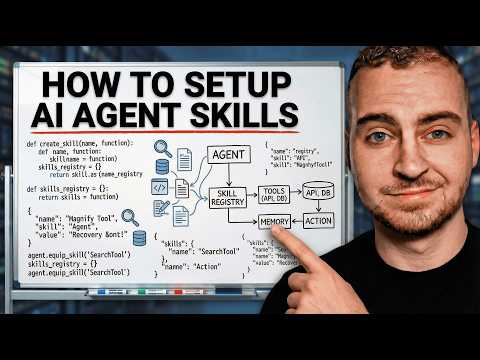
Tech With Tim
This guide explains how to implement and leverage AI 'skills'—repeatable, context-aware workflows—within modern AI coding environments to improve consistency and efficiency. It demonstrates how to move beyond basic prompting by creating reusable instructions that allow AI agents to handle complex tasks dynamically.
Key Takeaways
- Shift from simple repetitive prompts to structured 'skills' to enable AI agents to execute consistent, complex workflows.
- Use skills to encapsulate specific coding conventions, project requirements, or daily operational tasks that require repeatability.
- Skills optimize context usage because agents only load the necessary instructions dynamically rather than congesting the prompt with irrelevant data.
- Leverage AI to generate its own skills from documentation, allowing for rapid iteration and professional-grade workflow management.
Talking Points
Pro Analysis
Importance of the Concept
This transition from 'prompt engineering' to 'workflow engineering' is a critical maturation point for AI-assisted development. By codifying best practices into skills, developers transform agents from unpredictable assistants into reliable teammates that follow specific team standards (like API route separation).
Target Audience
Developers and knowledge workers dealing with repetitive tasks will benefit most. It is particularly relevant for lead developers managing teams, as skills act as an 'executable documentation' that can be shared.
Contrarian Takeaway
The non-obvious takeaway is that human-written code is becoming less important than human-defined processes. Spending time manually coding a feature is often a wasted effort compared to spending that same time teaching an agent a new 'skill' that can build that feature—and its associated tests—repeatedly and consistently in the future.
Time saved:
Written by: 1 Minute Signal Editorial Team