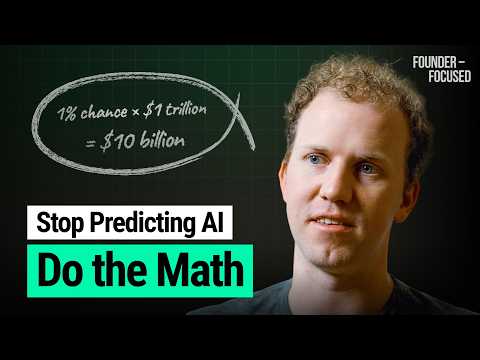
He Raised $26M Betting on Probabilities, Not Guesses | Koah Labs, Nic Baird

Video thumbnail: He Raised $26M Betting on Probabilities, Not Guesses | Koah Labs, Nic Baird
Jun 3, 202615m 17s video lengthEO

The Signal

Nick Barrett, CEO of the ad monetization platform KA Labs, argues that current consumer resistance to sharing personal data with AI agents necessitates a model beyond subscription-based revenue. He asserts that ads can actively improve user engagement, a claim he supports with an internal test that showed lower ad frequency correlated with higher churn. The central dispute remains whether AI utility will eventually reach a point of trust where users delegate high-stakes financial decisions to agents, or if current adoption thresholds will remain constrained to low-consequence tasks.

The Case

  • KA Labs, which reports having raised $26 million and reaching single-digit millions of users, pivoted from an agentic professional social network to an ad platform after discovering that users were too cautious to grant agents access to their email or personal communications.12:59
  • Barrett justifies his current business by citing an internal experiment where reducing ad frequency by 90% led to a significant drop in organic engagement and an increase in user churn, which he interprets as evidence that ads can be additive to the user experience.11:41
  • The founder frames his career and business strategy through an expected-value lens, explicitly stating that he prioritizes opportunities with high potential, such as a 1% chance at a trillion-dollar outcome, over safer but lower-ceiling alternatives.4:58
  • Illustrating the current limits of automation, Barrett suggests that while users might permit an AI agent to purchase a low-trust item like socks, they remain inherently avoidant of delegating high-stakes tasks like buying a car or managing an investment portfolio.14:15
  • Barrett credits the startup community South Park Commons with his transition from elite, competitive sailing to entrepreneurship, claiming the environment provided the exposure and confidence he previously lacked to build businesses independently.5:42
  • The company’s monetization thesis is built on the reality that AI inference costs are high, with one example instance citing a children’s story app losing tens of thousands of dollars monthly despite significant user interest, a problem Barrett claims subscription models often fail to solve.9:48

The 1 Minute Signal Take

Barrett presents a coherent, albeit self-serving, case for why ads might be a necessary evil for early-stage AI products, though his reliance on a single internal test to generalize that "ads improve engagement" is overconfident. The evidence clearly supports his observation that consumer trust in AI agents currently lags behind technological capability, confirming that high-stakes automation is still nascent. Watch this video for his pragmatic take on probabilistic decision-making and the role of community in founder formation; skip it if you are looking for an independently audited analysis of AI monetization models.

Pro Analysis

Strategic Significance:

  • This content demonstrates a critical tension in the AI economy: the divergence between VC-favored subscription models and the reality of hyper-expensive inference costs. It clarifies that monetization is as much a UX challenge as a financial one.

Who Should Care:

  • AI founders and product managers facing high burn rates should care about the viability of alternative monetization; investors should care about the shift in sentiment regarding 'ad-supported' AI experiences.

Contrarian Takeaway:

  • Ads are not merely a monetization tool of last resort; they can function as a product enhancement that drives retention if the volume and quality are tuned correctly, contradicting the industry-wide dismissal of ad-based models.
Time saved:12m 33s

Share this

Tags