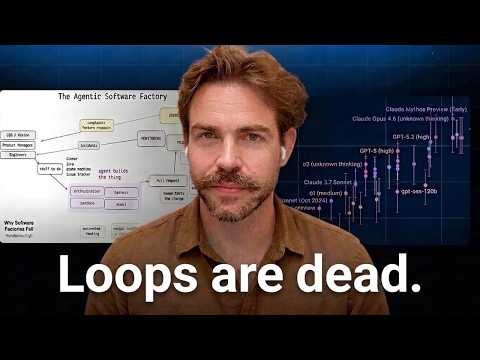
Ex-NASA dev reveals his Agentic Engineering Workflow

Video thumbnail: Ex-NASA dev reveals his Agentic Engineering Workflow
Aug 7, 202658m 37s video lengthDavid Ondrej

The Signal

Autonomous coding agents excel at solving isolated problems but fail to reliably produce maintainable code without human oversight. Relying on a 'light soft factory'—minimizing human code review—risks long-term technical debt and expensive debugging, as demonstrated by a real-world multi-week failure in July 2025. The core tradeoff is between short-term speed and long-horizon codebase health.

The Case

The Operational Reality

  • The most effective agentic workflow forces high-signal planning upstream: define product intent, system architecture, and program design before execution.0:09
  • Attempting a 'light soft factory'—where humans stop reading code—consistently resulted in 'slop' and eventually led to weeks of painful debugging on a desktop app project.7:09
  • Agents perform best when they are given measurable outputs, such as specific conversion rates or deterministic test pass/fail criteria, which provide the agent with a clear target for optimization.

The Architecture of Work

  • Context engineering is a physical constraint problem; models degrade in a 'dumb zone' around 100,000 tokens, necessitating session compaction or resets to maintain performance.41:46
  • Current coding benchmarks like SweBench are limited because they reward one-shot patching and fail to penalize the long-term code health, maintainability, or 'slop' produced by models.1:02
  • To manage complex systems, teams should build in vertical slices—end-to-end functionality paths—rather than horizontal sweeps, allowing for easier course correction before context locks in.19:21

Strategic Framing

  • The real competition for startups is not just against large labs, but against the internal pace of product managers at those labs; execution and finding niche problems remain the primary levers.52:10
  • Teams should automate incident triage—such as routing outages to agents for root-cause classification—to reduce the manual burden of reading raw monitoring alerts.4:02
  • Operational rigor should scale with risk; heavier, more structured design and review processes are necessary for Series B or fintech-stage companies where a single release error can result in massive trust loss.15:29

The 1 Minute Signal Take

Do not attempt to eliminate human code reading entirely, as current models cannot yet substitute for the tacit architecture and maintenance judgment of an experienced engineer. Use agents as a force multiplier for well-defined, measurable tasks, but keep the human in the loop for complex system design and incident validation.

Pro Analysis

Why It Matters

This content serves as a necessary reality check for the 'AI-will-replace-everyone' narrative. By grounding the discussion in a high-stakes failure, it highlights that the primary constraint in software engineering isn't writing lines of code, but maintaining the structural integrity of the system as it evolves.

Strategic Implications

Teams should view agents as powerful leverage that requires higher-level architectural discipline, not as a shortcut to bypassing design. If you cannot describe your system in a clear, document-driven way, the agent will inevitably produce technical debt that costs more to fix than it saved to create.

Evidence & Hype Audit

This content is highly trustworthy because it relies on first-hand accounts of operational failure rather than marketing claims. While it includes plugs for specific tools, the underlying advice on workflow architecture is vendor-agnostic and aligns with well-established software engineering principles (e.g., vertical slices, modularity).

Counterarguments

Critics might argue that agentic progress is exponential and that human review will become obsolete as models develop stronger self-correcting capabilities. However, even if agents get better at testing themselves, the requirement for human product intent remains; someone must still define what to build, regardless of who writes the code.

Role-Specific Takeaways

  • Engineering Managers: Focus on designing processes for incident triage and modular documentation.
  • Individual Contributors: Focus on mastering 'context engineering' to maximize model accuracy.
  • Founders: Don't let your team 'vibe-check' a new feature; prioritize architectural rigor as soon as you hit PMF.

What to Do Next

  • Audit your documentation; move critical system logic into markdown within the repo.
  • Implement 'vertical slice' development for your next project to catch architecture errors early.
  • Set explicit success metrics (e.g., latency, cost, error rate) before prompting your agent.
  • Establish a routine to purge stale context files to keep the agent focused.
  • Create a simple incident-triage script to automate the analysis of routine uptime events.
Time saved:55m 9s

Share this

Tags

Written by: 1 Minute Signal Editorial Team