
Why It Matters
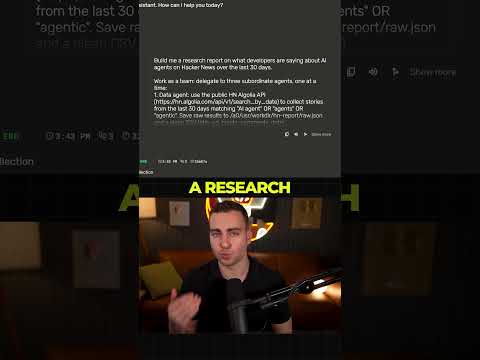
Agent Zero represents a shift from 'AI as a chatbot' to 'AI as an autonomous orchestration layer.' By utilizing a Dockerized Linux environment, the agent gains persistent file access and the ability to modify its own capabilities in real-time. This moves the bottleneck away from the model's training data and toward the model's ability to execute code to interface with the world.
Strategic Implications
This architecture suggests a future where users no longer need to manage 'tooling suites' or 'plugins.' Instead, the agent adapts to the environment it is placed in. Organizations adopting this model may see significant reductions in manual data synthesis time, but they must also contend with the 'black box' nature of how sub-agents coordinate and verify the accuracy of their findings.
Evidence & Hype Audit
The content is highly promotional and leans on narrative examples rather than rigorous benchmarking. It demonstrates a workflow successfully but offers no evidence regarding the accuracy, hallucination rates, or completeness of the resulting research reports. The claims regarding 'general-purpose' capability are currently assertions, not established facts.
Counterarguments
A significant contrarian view is that deep decomposition into sub-agents can introduce cascading errors. If the data agent fails to retrieve high-quality information, the subsequent analysis and writing agents will produce a coherent, yet entirely flawed, final report. The 'team' metaphor masks the fact that these agents often lack context of each other's internal state beyond a final output.
Who Should Care
- Software Developers: Interested in the integration of Docker environments with LLMs.
- Operations Managers: Focused on automating long-form research and data synthesis tasks.
- Product Researchers: Seeking faster methods for monitoring trends across developer communities.
What to Do Next
- Verify the outputs of Agent Zero against established manual research to identify potential drift or hallucination.
- Audit the security implications of providing an agent with a full Linux environment inside Docker.
- Establish clear validation checkpoints between sub-agent handoffs.
- Compare the time-to-delivery of agent-generated reports versus traditional manual synthesis.
- Limit agent permissions within the container to prevent unintended file modifications.