
Why It Matters
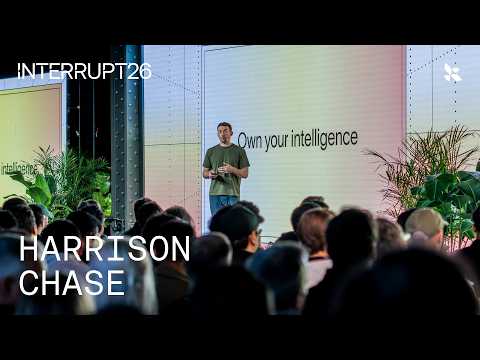
This keynote signals a maturity milestone in the agentic AI market. By moving the conversation from 'what model are you using' to 'how are you governing your agent infrastructure,' the industry is acknowledging that reliability and cost management are now the primary barriers to enterprise adoption.
Strategic Implications
Organizations should treat AI as a persistent engineering stack rather than an API-call sequence. The focus on model-neutrality via harnesses is a hedge against provider lock-in and pricing volatility. Furthermore, the introduction of 'decision models' suggests that architecture will increasingly rely on a mix of specialized, lightweight models rather than one massive model for every sub-task.
Evidence & Hype Audit
This is vendor-led, promotional content. While the technical logic is sound and the architectural patterns (observability, gateway, harness) are industry standards, the performance and necessity of specific proprietary tools like Jev or LangSmith Engine remain unverified by third-party benchmarking.
Counterarguments
Critics may argue that adding layers of proprietary 'harness' and 'gateways' introduces significant vendor lock-in of a different kind. Relying heavily on a platform's 'intelligence layer' creates a dependency where users may lose the ability to easily swap out orchestration logic if that platform's API or feature set evolves in a direction that breaks their specific workflow.
Who Should Care
- Platform Engineers: Need to evaluate the cost-to-benefit ratio of adopting a unified gateway vs. rolling their own.
- Agent Builders: Should prioritize standardized trace formats (trajectories) to future-proof their fine-tuning pipeline.
- CTOs: Should scrutinize governance capabilities for internal agents to avoid cost leakage and security gaps.
What To Do Next
- Conduct a audit of your current agent infrastructure to identify where hard-coded model calls can be replaced with model-neutral abstractions.
- Standardize your agent logging format to align with trajectory-based patterns to facilitate future model fine-tuning.
- Implement a centralized gateway for your AI traffic to gain immediate visibility into spend and model performance.
- Evaluate your most critical agents for potential conversion to a model-neutral harness to ensure you can rotate underlying LLMs without rewriting core business logic.