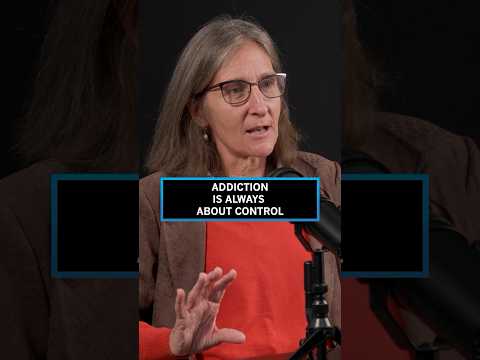
Why Addiction is a Control Problem | Dr. Anna Lembke

Video thumbnail: Why Addiction is a Control Problem | Dr. Anna Lembke
Nov 11, 20261m 2s video lengthAndrew Huberman

The Signal

In the severest cases of addiction, the primary driver is not the substance or behavior itself, but an underlying compulsion to assert control. This framing posits that human behavior functions as a continuous prediction-management process, where the individual seeks to minimize uncertainty by either updating their internal mental model or forcing reality to align with it.

The Case

  • The speaker argues that in extreme addiction, the craving for the substance is a surface-level manifestation of a deeper, adaptive drive to control the environment and reduce uncertainty.0:00
  • Human action is modeled as a binary response to prediction error: one can either update the internal "map" to accommodate new information or "update the world" to make external conditions match existing expectations.
  • "Updating the world" is operationalized as behavior meant to resolve uncertainty, such as foraging for more data or redirecting attention toward inputs that confirm one’s prior mental model.
  • The speaker posits that successful predictions are inherently reinforcing and trigger the release of dopamine, cementing the individual's commitment to their existing internal model.0:20
  • The thesis that severe addiction is fundamentally about control is asserted without evidentiary support, and the explanation of neurochemical processes like dopamine release remains a conceptual model rather than a demonstrated mechanism.

The 1 Minute Signal Take

This model offers an interpretive framework for understanding compulsive behavior as a functional, if extreme, strategy for managing uncertainty. While the speaker provides a coherent conceptual structure, note that the core claim regarding severe addiction remains an unverified hypothesis rather than established clinical consensus.

Pro Analysis

Why It Matters

This framework shifts the clinical and personal conversation regarding addiction from 'substance management' to 'uncertainty management.' If the primary driver is a lack of control, traditional harm-reduction strategies that ignore the underlying motive may fail to address the root cognitive compulsion.

Strategic Implications

For individuals, this model suggests that overcoming addiction requires high-level cognitive flexibility—the ability to tolerate the pain of 'updating the map' rather than constantly attempting to 'update the world.' For clinicians, it argues for interventions that focus on cognitive tolerance and uncertainty processing rather than just abstinence.

Evidence & Hype Audit

This content is highly theoretical. The speaker presents an interpretive framework (predictive processing) but does not provide clinical evidence or specific data to prove that severe addiction is exclusively a control problem. It is a compelling philosophical hypothesis, not a peer-reviewed clinical finding.

Counterarguments

Critics might argue this model oversimplifies addiction by ignoring biological, physiological, and socioeconomic variables. By labeling it a 'control problem,' one risks pathologizing natural human agency or ignoring the neurobiological realities of physical dependency.

Who Should Care

  • Clinicians: To consider if their patients are using substances to fix a perceived lack of control.
  • Individuals in Recovery: To analyze if their relapses are triggered by uncertainty or anxiety regarding their environment.
  • Cognitive Psychologists: To examine if the 'update the world' model is a useful metaphor for compulsive behavior.

What to do next

  • Map your recurring behaviors to see if they follow the 'update the world' pattern.
  • Practice sitting with uncertainty without reaching for a digital or physical corrective mechanism.
  • Identify the specific scenarios where you feel the need to force an outcome.
  • Reflect on whether your recent actions were meant to change reality or your own mental perspective.

Share this

Tags

Written by: 1 Minute Signal Editorial Team