
- AI engineering is essentially software engineering that incorporates AI models.
- The industry values practical experience and shipping code over research and theoretical prowess.
- Avoid spending months learning calculus before writing a backend API call.
- Successful engineers balance surface-level knowledge with deep expertise in one specific niche.
- Always prioritize deploying applications to the web, even if they are simple, to understand production constraints.
- Aim to solve actual problems you or your workplace face to make your portfolio stand out.
- Active learning yields 75-90% higher information retention compared to passive viewing.
- Do not get discouraged by the rapid flux of AI frameworks; focus on the architectural principles that endure.
How NOT to Become an AI Engineer
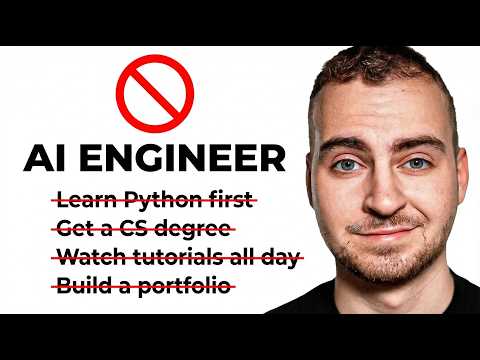
Tech With Tim
This video outlines seven recurring pitfalls that beginners face when attempting to enter the field of AI engineering. It emphasizes transitioning from passive theory-focused learning to practical, product-oriented software development.
Key Takeaways
- Shift focus from heavy theoretical math to building functional applications on top of existing foundation models.
- Prioritize core software engineering skills, including version control, testing, and deployment, over niche AI frameworks.
- Counteract tutorial hell by spending 80% of time on active coding and project building rather than passive content consumption.
- Specialize in one area of AI engineering at a time to build depth rather than spreading efforts too thin across too many tools.
Talking Points
Pro Analysis
This content is highly strategic because it challenges the 'academic' gatekeeping surrounding AI careers. Many aspirants lose months attempting to become computer science researchers when the immediate industry demand is for pragmatic builders who can connect existing API intelligence to business workflows.
Why it matters:
Organizations are currently awash in prototypes that cannot scale. Candidates who understand production logistics—like rate limiting, cost control, and latency—are significantly more employable than those who only know how to run a notebook locally.
Who should care:
Budding AI developers, career-switchers in tech, and recruiters trying to identify genuine engineering talent versus those who merely repeat boot-camp projects.
Contrarian Takeaway:
Building 'worse' projects that actually ship is better than building 'perfect' projects that sit on a GitHub repository. An amateur tool that solves one real frustration for a real person is more valuable for your career than a complex, polished AI demo that serves no one.
Time saved:
Written by: 1 Minute Signal Editorial Team