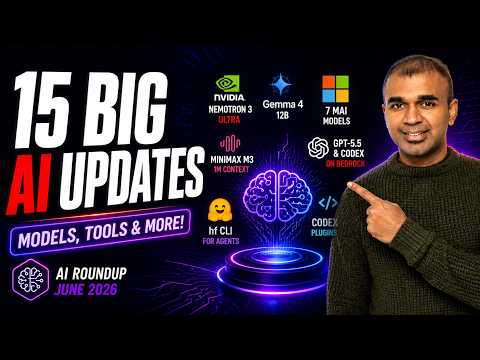
15 AI Updates You Missed This Week (Nemotron, Gemma 4, MAI & More)

Video thumbnail: 15 AI Updates You Missed This Week (Nemotron, Gemma 4, MAI & More)
Jun 9, 20265m 53s video lengthMervin Praison

The Signal

Recent AI product announcements confirm a broad pivot toward agent-based orchestration, long-context desktop control, and hardened production infrastructure. While performance claims remain largely vendor-asserted, the sector demonstrates a shifting consensus: because human-in-the-loop review processes are hitting scale limits, future safety hinges on technical containment layers rather than simple approval workflows.

The Case

Model & Infrastructure Releases

  • Nvidia released Neotron 3 Ultra, a 550B-parameter orchestrator designed for long-running agents with a 1M-token context window.0:39
  • Microsoft launched seven MAI models at Build 2026, including specialized variants for coding and thinking; Microsoft claims these models demonstrate parity with GPT-5.4 at 10x the efficiency.1:23
  • Amazon Bedrock added GPT-5.5, GPT-5.4, and Codex, requiring operators to manually verify guardrail parity before migrating workloads between vendors.2:06
  • OpenAI’s Codex is evolving into a platform, now supporting over 60 apps and 110 skills, signaling a move toward integrated agent marketplaces and review-loop workflows.

Containment & Safety

  • Anthropic released the Defending Code reference harness, emphasizing that autonomous agent loops require gVisor environments and strict egress controls to manage blast radius.3:50
  • Anthropic mapping data suggests that AI-equipped threat actors have shifted tactics, with medium-plus risk activity rising from 33% to 56% as attackers prioritize post-compromise discovery over initial phishing.5:11
  • Holo 3.1, a 35B-parameter model for local desktop control, is explicitly marketed for use only inside VMs or containment, with the provider warning against running it on production-critical desktops.3:10
  • Meta’s Muse Spark API remains significantly delayed, lacking a model card or service-level agreement as of early June, leading to developer warnings against hardcoding dependencies on the service.5:33

The 1 Minute Signal Take

The industry is moving past simple chat interfaces toward autonomous agent tools that require rigid, hardware-level isolation to mitigate risk. If you are building on these models, assume that human supervision is a fragile control; prioritize sandboxing and egress filtering as your primary security boundary.

Pro Analysis

Why It Matters

This roundup signals the end of the 'model-as-a-service' novelty phase. We are now in the 'model-as-infrastructure' phase, where the value proposition is defined by how well a model integrates into—and controls—existing software loops. The convergence of long contexts (1M tokens) with desktop-control capabilities fundamentally changes the threat and utility surface for enterprise IT.

Strategic Implications

Businesses now face a choice between standardized vendor ecosystems (e.g., AWS/Bedrock, Azure/MAI) or fragmented, high-performance open-weight solutions (Holo/Miniax). The strategic imperative is no longer model selection, but containment management. The winners will be those who can deploy these models into 'hard' sandboxes without degrading the agent's ability to operate.

Evidence & Hype Audit

Much of the content comprises vendor-reported benchmarks and capability claims (e.g., Nvidia's throughput, Microsoft's efficiency). These are anecdotal. The most reliable information here relates to deployment constraints and product roadmap status (e.g., Meta Muse Spark’s missing SLA), which serves as a necessary warning against premature production integration.

Counterarguments

Critics might argue that the push toward agent marketplaces and plugins creates a dangerous layer of technical debt. By over-relying on internal 'skill' directories, organizations may be creating hidden dependencies that are impossible to audit or govern as these models evolve.

Who Should Care

  • CTOs/Architects: Plan for the infrastructure overhead of sandboxing and VM-based agent deployment.
  • Security Teams: Review the MITRE ATLAS post-compromise shifts to update monitoring playbooks.
  • Product Managers: Evaluate if your roadmap relies on delayed products like Meta Muse Spark, which present significant availability risk.

Action Items

  • Audit existing agent deployments against the 'containment-first' security model.
  • Standardize on gVisor or similar container-security tools for all autonomous agent execution.
  • Conduct a parity review for all Bedrock-connected applications to ensure guardrail compliance.
  • Shift from 'fishing' to 'discovery' focus in security monitoring playbooks.
Time saved:2m 44s

Share this

Tags

Written by: 1 Minute Signal Editorial Team