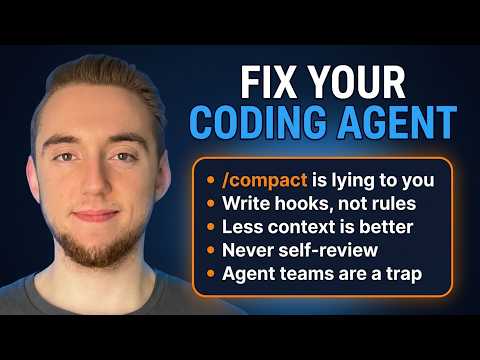
11 Tiny Coding Agent Fixes With A Stupid Amount Of Payoff

Video thumbnail: 11 Tiny Coding Agent Fixes With A Stupid Amount Of Payoff
Sep 1, 202617m 30s video lengthCole Medin

The Signal

Coding-agent reliability is not primarily a model-capability problem but a workflow-design problem. Rather than chasing larger models or complex orchestration, developers should enforce reliability through disciplined constraints: specifically, isolating review from authorship, utilizing deterministic event hooks, and regularly refreshing session context to prevent the accumulation of stale rules and self-reinforcing biases.

The Case

Workflow Discipline

  • Abandon the habit of letting coding agents approve their own work; implement a strict separation where a fresh conversation acts as a reviewer to eliminate self-confirmation bias.14:27
  • Stop using "slash compact" commands to manage context windows, as studies suggest only 10% of technical details survive summarization; prioritize smaller work units and handoff documents instead.4:13
  • Treat validation as a system by planning testing and edge-case checks before code is written, rather than treating them as after-the-fact verification steps.16:21

Controlling Agent Behavior

  • Replace probabilistic, instruction-based rules for critical tasks with deterministic "hooks" that trigger mandatory actions, such as running tests after implementation.5:33
  • Audit global rule files frequently to prevent "rule drift," where outdated instructions about file paths or dependencies conflict with the current codebase; keep these files under 300 lines to avoid context bloat.2:54
  • Avoid escalating to larger models mid-task when a session becomes unreliable, as the existing conversation context is already tainted by embedded errors; "burn it to the ground" by creating a handoff document and starting a fresh session.11:19

Complexity and Constraints

  • Shun complex multi-agent coordinator frameworks, which the speaker argues are experimentally unreliable, in favor of a single main agent acting as a simple delegator.13:10
  • Limit parallel sub-agent usage, as excessive fan-out consumes tokens rapidly and may contribute to hitting rate limits without a proportional gain in output quality.9:53
  • Resist the urge to over-revise code; studies indicate that after 10 to 20 iterations, early versions of the output are statistically more likely to be superior to the final, over-polished version.15:27

The 1 Minute Signal Take

You should shift from treating agents as autonomous problem solvers to managing them as specialized, context-sensitive processors. Reliability is best achieved by restricting the scope of each task and enforcing mandatory quality checks deterministically.

Pro Analysis

Why It Matters

The transition from experimental AI experimentation to production-ready coding workflows is currently bottlenecked by reliability. This content shifts the focus from model capability to human-designed workflow architecture, which is a necessary evolution for scaling AI-driven development.

Strategic Implications

The shift toward 'fresh sessions' and 'handoff documents' suggests that we are moving toward a modular, transient model of AI interaction. Instead of long-lived, monolithic chat sessions, developers should prepare for a paradigm where 'session hygiene' becomes a core technical skill.

Evidence & Hype Audit

The content relies heavily on anecdotal evidence and professional experience. While the recommendations are logical, they lack comparative benchmarking across different coding agents. The mention of 'cited studies' regarding rule rot and iteration quality remains opaque, suggesting the speaker is referencing internal observations rather than peer-reviewed data.

Counterarguments

Critics might argue that restricting context and rules ignores the future potential of agents to self-correct and self-manage. By enforcing strict hooks and manual handoffs, we might be 'hard-coding' limitations on an agent's ability to reason dynamically about complex, non-linear architectural problems.

Role-Specific Takeaways

  • DevOps/Platform Engineers: Prioritize building automated hook-based test triggers for your agents.
  • Individual Contributors: Focus on maintaining small, clean session history and separating your drafting from your review process.
  • Engineering Managers: Review team rule-files to prevent 'rule rot' and discourage the use of overly complex multi-agent frameworks.

What to do next

  • Audit all global instruction files and prune generic advice.
  • Implement a deterministic hook for test execution.
  • Establish a 'handoff' template for transitioning tasks between sessions.
  • Enforce a mandatory 'fresh session' review step for all PRs generated by AI.
  • Monitor your token usage to identify if parallel sub-agent usage is causing rate-limit issues.
Time saved:14m 12s

Share this

Tags

Written by: 1 Minute Signal Editorial Team